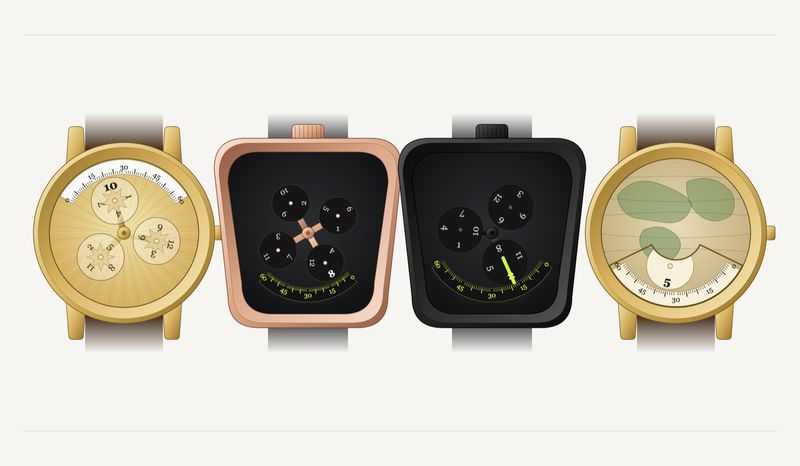



Audemars Piguet is the Royal Oak company, which is exactly why the Star Wheel is worth knowing. In 1991 the most conservative-looking watch in the catalogue — 36mm, precious metal, stepped bezel, short lugs — turned up with no hands at all. Three sapphire discs drifted across a 120-degree arc of minutes instead, a display borrowed from a night clock built for a sleepless Pope in the 1650s. It sold slowly and faded from the catalogue within the decade, resurfaced in cushion-cased minute repeaters, an oval anniversary edition and a two-faced pocket watch, then disappeared for nearly twenty years until the Code 11.59 Starwheel arrived in December 2022.
This page sets down what can actually be documented about all of them: every reference we could verify, every dial we could evidence, the production figures Audemars Piguet has published — and, just as important, the ones nobody has. Where sources disagree, we say so and show both. Numbers in superscript point to the sources at the foot of the page.
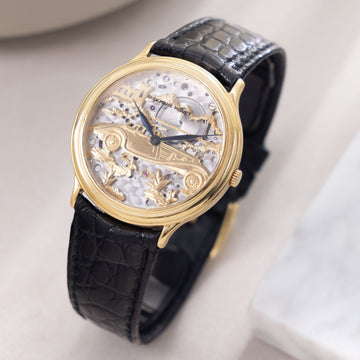
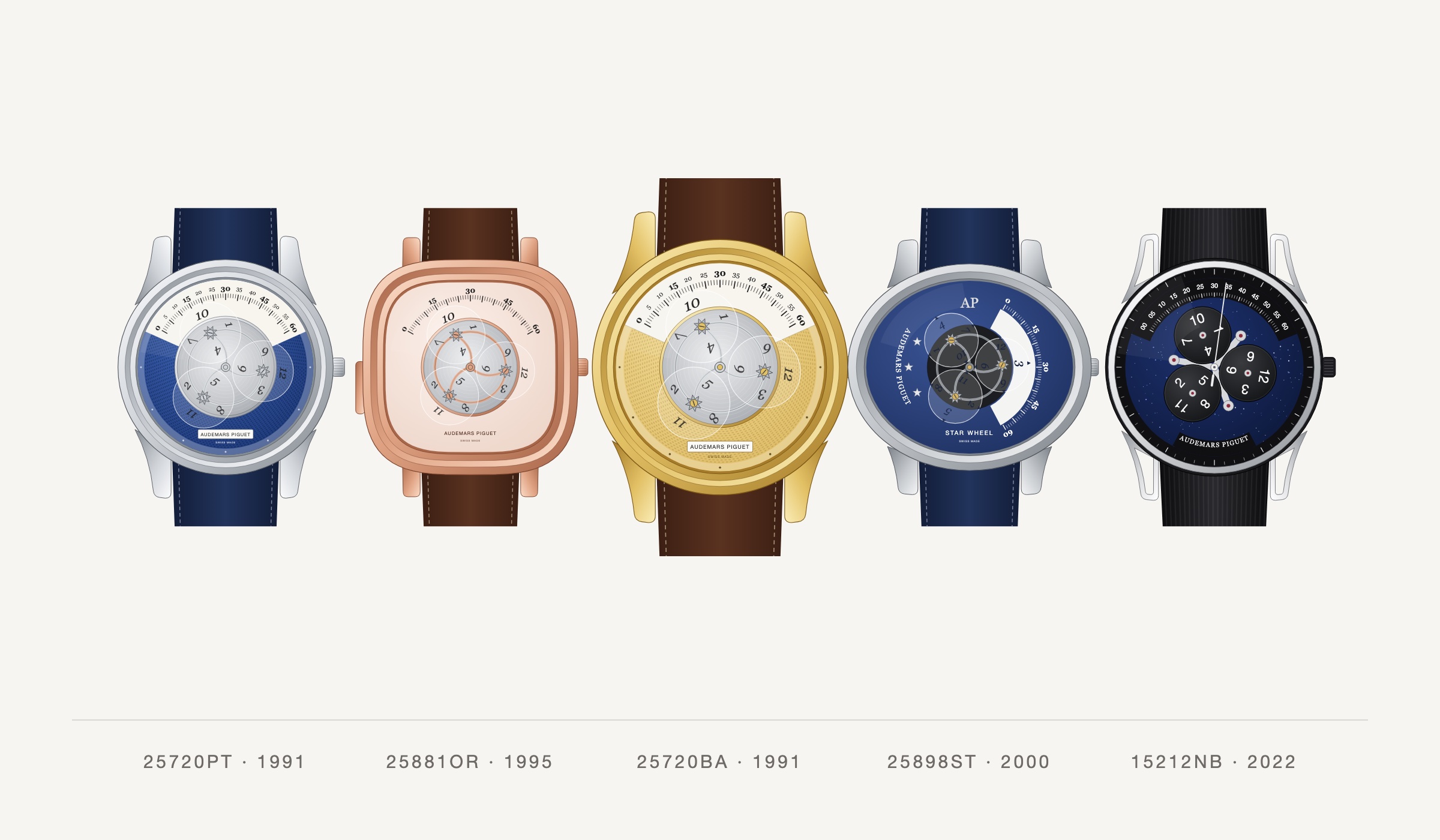
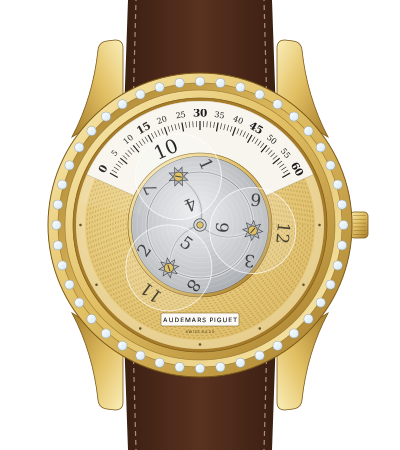
About the pictures. Almost every photograph of a Star Wheel belongs to an auction house, a dealer or Audemars Piguet, so rather than lift them we drew each reference and dial variant ourselves. The drawings are schematic — case shape, metal, layout, dial finish and colour are researched; fine detail is simplified — and each caption links to a photographed example. The one photograph on the page is a freely licensed image from Wikimedia Commons.
At a glance
- First shown
- 1991, as ref. 25720, after 18 months of development2
- The idea
- Wandering hours, devised around 1655 by the Campani brothers of Rome for Pope Alexander VII1, 5
- The display
- Three sapphire discs of four numerals each, on a carrier that turns once every three hours, reading against a 120° minute sector
- Original movement
- Selfwinding cal. 2124 on a LeCoultre blank, with AP's own wandering-hours module — “2124/2812” in AP's archive3, 4
- Size of the family
- Around 30 Star Wheel models between 1991 and 2003, by AP's own count2
- Case shapes
- Round (25720, 25746), cushion (John Shaeffer 25881), oval (Millenary 25898), pocket (25743, 25913), Code 11.59 (15212)
- Published production
- 25881: 17 units · platinum 25881: 10 · titanium closed-dial: 3 · Millenary: 250 · ref. 25720: never published
- In the catalogue today
- Code 11.59 Starwheel, 41mm, cal. 4310 — ref. 15212NB (2022) and ref. 15212NR (2025)
A Pope who couldn't sleep
The display is far older than the wristwatch. Alexander VII, elected Pope in 1655, is said to have complained that the clock in his apartments kept him awake and, worse, could not be read in the dark. The problem went to the Campani brothers — Giuseppe, Matteo and Pietro Tommaso — clockmakers in Rome.5, 6 They answered both halves of it: a silent escapement in place of the tick, and a dial with an arched window across which the hour itself travelled, the quarters marked along the edge, all lit from behind by an oil lamp so that it glowed at night. The papal privilege that followed let them build night clocks for courts across Europe; one survives in the British Museum.5
Audemars Piguet's heritage director dates the invention to 1655;1 auction catalogues more cautiously say the second half of the seventeenth century.13 Either way the idea never quite died. In the 1920s and 1930s a Le Locle watchmaker, Robert Cart, patented a wandering jump-hour that Breguet and Vacheron Constantin both used in pocket watches5 — and then it went quiet again for half a century.
From a journal article to ref. 25720
AP's account of the revival is short and specific. In 1989 one of its watchmakers came across the wandering-hours system in an article in the Journal suisse d'horlogerie. Eighteen months of development later, in 1991, the manufacture presented its first wandering-hours wristwatch as reference 25720.2 Even AP hedges on the name: “Star Wheel”, it says, probably refers to the three star-shaped wheels that carry the sapphire hour discs on the large central wheel.2 One dealer history adds that the work earned a patent.7
The timing mattered. By 1991 AP was the Royal Oak brand, and two years later it would be the Offshore brand too. The Star Wheel went the other way: it reused the slim 36mm case of the ultra-thin perpetual calendar ref. 5548 and the Dual Time ref. 25685, with a double-stepped bezel, short down-turned lugs and an unsigned crown.5 It was a dress watch with a display that made people look twice — and then, mostly, buy something else.
How the Star Wheel tells the time
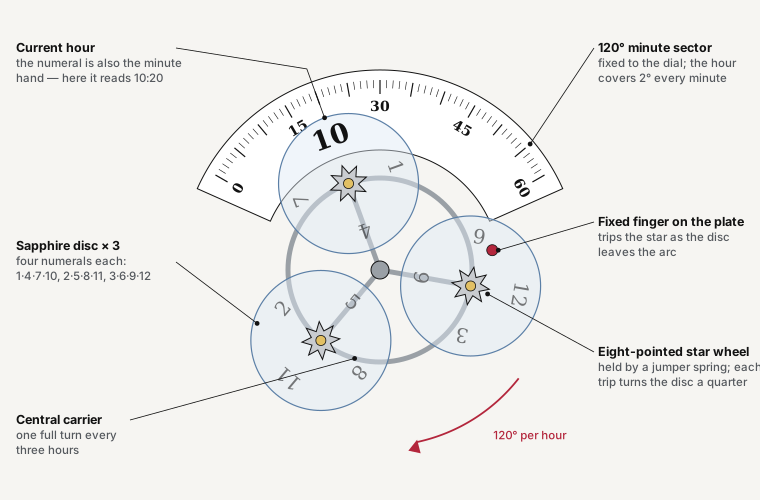
There is one moving assembly and one fixed scale. A central carrier turns once every three hours. On it sit three transparent sapphire discs, each free to turn on its own axis and each printed with four numerals — 1·4·7·10 on the first, 2·5·8·11 on the second, 3·6·9·12 on the third.1, 5 The minute scale is an arc of 120 degrees across the top of the dial, from roughly ten o'clock to two. Because the carrier covers 120 degrees an hour, the numeral that is “live” sweeps the arc at two degrees a minute and doubles as the minute hand. As it leaves at 60, the next disc arrives at 0.
The star wheels are what make it work. Each disc rides on an eight-toothed star held by a jumper spring, and as a disc passes out of the minute arc it is tripped round by 90 degrees so that its next numeral faces outward the next time it comes round.5, 6 Unlike older wandering-hours watches, which hid everything but a window, AP put the whole mechanism on show through the sapphire.
That choice has a cost. A jump every hour draws more from the mainspring than a date change once a day, and spring-held stars add friction. When Felix Baumgartner developed Urwerk's first satellites later in the decade he went to a Maltese cross instead, for exactly that reason5 — which is a fair measure of how far ahead of the field the Star Wheel was. There is no seconds hand, although the base calibre kept its hacking seconds.5
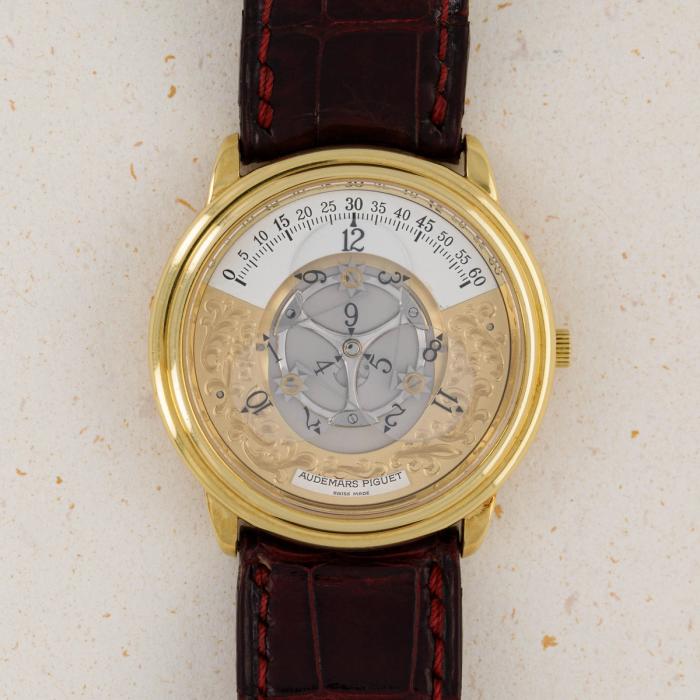
Reference 25720, the original

| Launched | 19912 |
| Case | 36mm across, about 9mm thick; double-stepped bezel, short down-turned lugs, unsigned crown; snap-on sapphire display back; hallmark on the flank or between the lugs5, 7, 10 |
| Metals | Yellow gold (25720BA) and platinum (25720PT) at launch; pink gold (25720OR) added later;5 white gold (25720BC) is listed by reference databases but we found no auction-catalogued example28 |
| Dial | Solid gold matched to the case — white gold on platinum — engine-turned or hand-engraved; eggshell-white minute sector between 10 and 2; applied “Audemars Piguet” plaque at 65 |
| Movement | Selfwinding cal. 2124 with AP's wandering-hours module; 21-carat gold rotor segment; catalogued by auction houses at 33 jewels.9, 10 AP's archive records a 1992 platinum example as cal. 2124/28123 |
| Base calibre | 11½-ligne (26mm), 3.25mm thick, 21,600 vph, about 50 hours, on a LeCoultre blank — the JLC 889 family4, 5 |
| Full-format references seen | 25720BA.OO.A002XX.01; 25720OR.OO.0002XX.04; 25720/002OR11, 12, 28 |
| Last UK retail price | £11,450, according to a collector quoted by A Collected Man5 |
A word on calibre numbers. You will see the movement written as 2124, 2124/2811, 2124/2812 and 2224 — sometimes in the same listing. AP's own heritage site explains most of it: cal. 2124 ran from 1983 on movement blanks that LeCoultre supplied until 1996, at 21,600 vph; its successor, cal. 2224, ran from 1999 to 2004 at 28,800 vph.4 So a 25720 should carry a 2124, and the 2000 Millenary a 2224. The suffix is the module: AP's archive caption says 2812 for the 25720,3 while Monochrome's review of the Millenary gives 2224/2811.19 We have not seen AP reconcile the two.
When did it end? The usual answer is 1996: A Collected Man's history has the model discontinued within five years, in the same clear-out that ended AP's whole family of 36mm stepped-bezel classics.5 The watches themselves complicate that. AP's archive dates a platinum example to 1992;3 Sotheby's sold a pink-gold one confirmed as made in 1994;11 Phillips and Sotheby's both date platinum examples to around 1997;9, 10 Antiquorum put one at around 1998;14 and a pink-gold watch has surfaced with a guarantee dated 1999.12 Our reading: catalogued for roughly five years, then cased and sold in a trickle to the end of the decade — which also squares with AP counting Star Wheel models all the way to 2003.2
Dial variants of the 25720
The reference came with two dial finishes from the start: engine-turned (a fine barleycorn guilloché) or hand-engraved arabesques, the latter much the scarcer.5 In both, the lower dial is solid gold in the colour of the case, and the platinum watch takes a white-gold dial. Nothing on the dial says “Star Wheel”; the name would not appear on a watch until 2000.
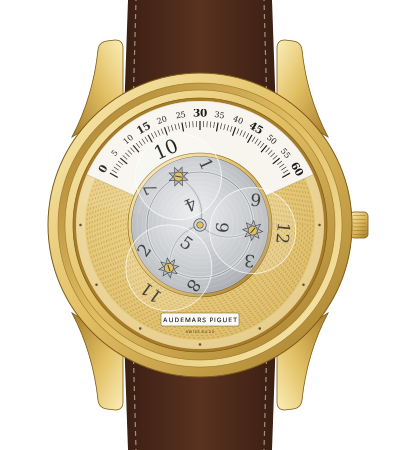
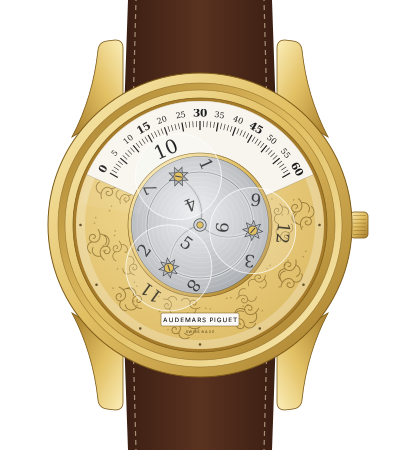
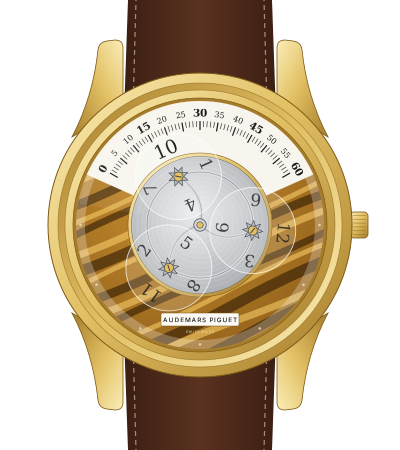
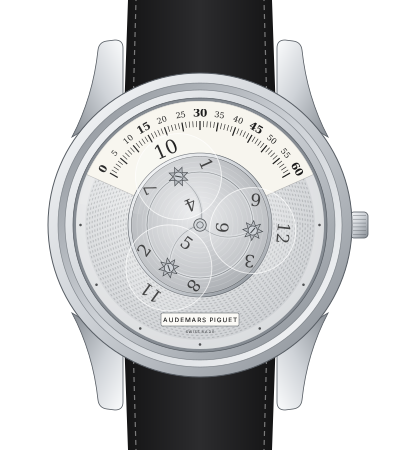
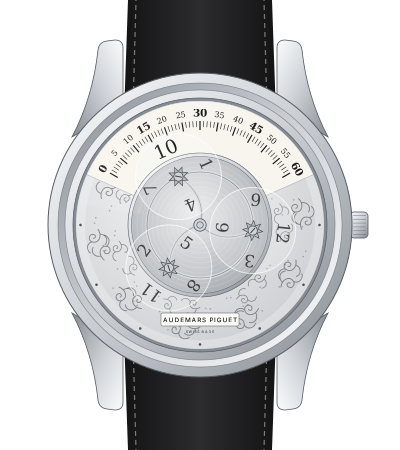
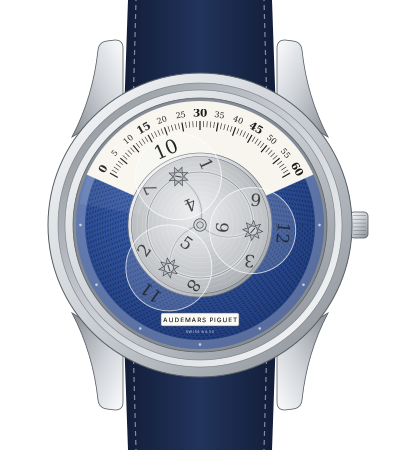
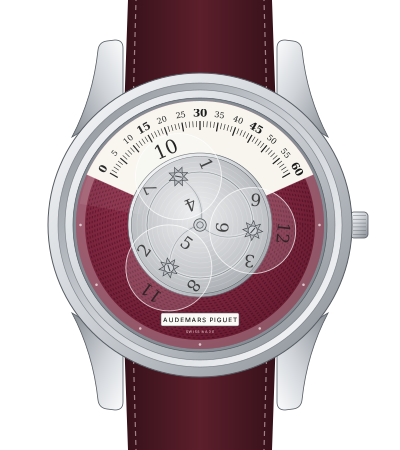
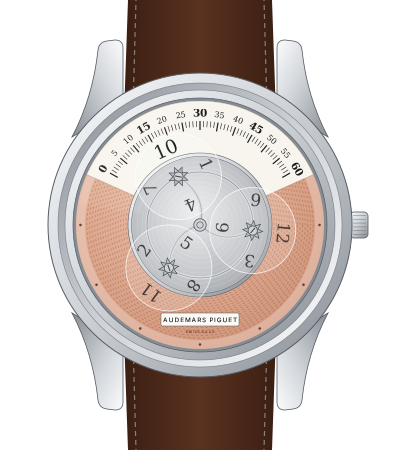
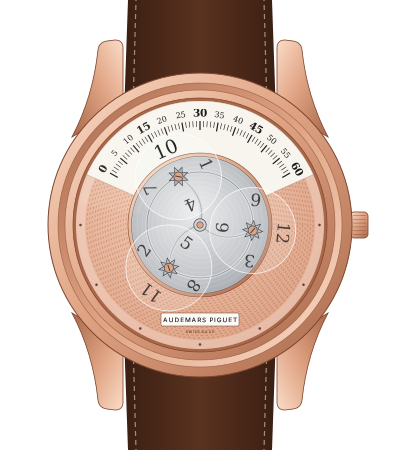
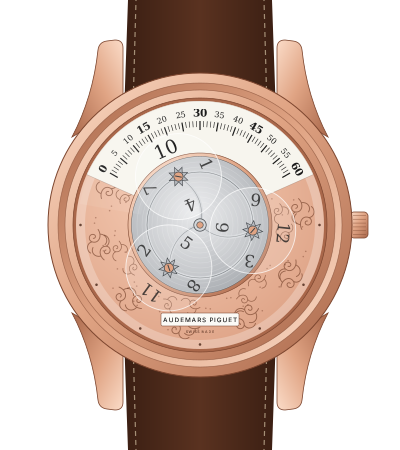
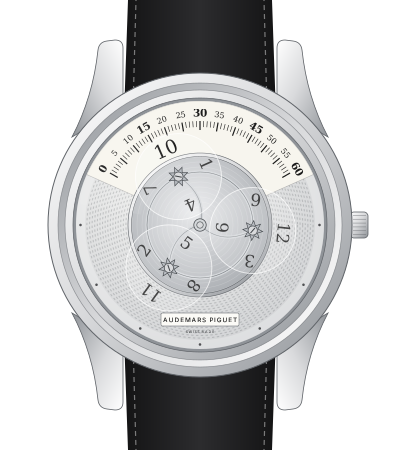
The blue-to-burgundy question. Platinum Star Wheels turn up with lower dials described as blue, purple, burgundy, red and pink copper. A collector quoted by A Collected Man recalls a blue tone being offered for platinum, and says he has seen burgundy and tiger's-eye dials without ever finding them in AP literature.5 Hairspring, which has handled several, records blue and burgundy in both guilloché and engraved form and floats the obvious theory: that they all left Le Brassus blue and have aged along different paths.8 Phillips catalogued one as pink copper in 2019; Antiquorum catalogued another as tropical purple in 2022.9, 14 Until AP publishes the dial records, treat any colour other than blue as unproven-original — beautiful, rare, and worth an Extract from the Archives before you pay for the story.
Gem-set, openworked and unique pieces
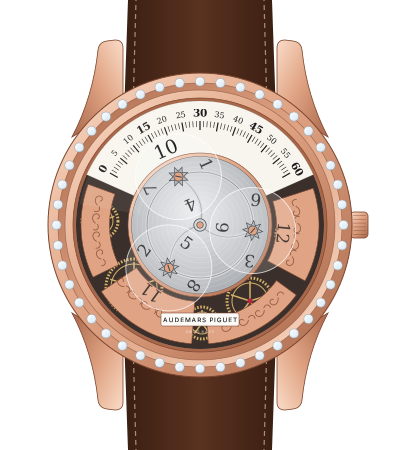
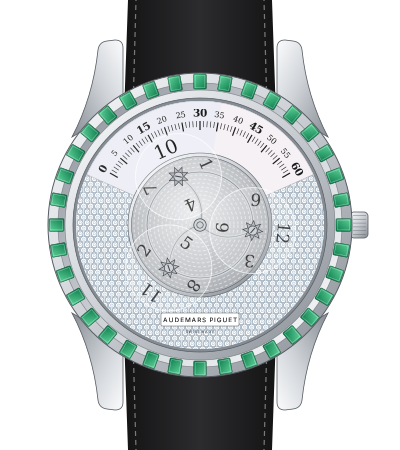
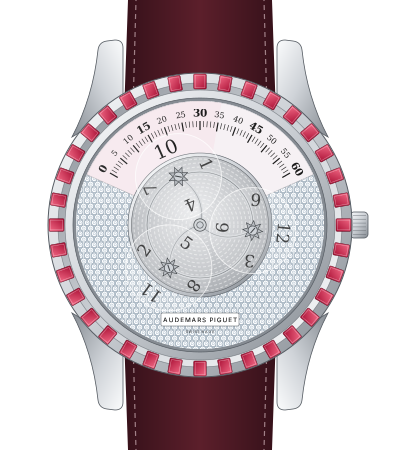
AP's press history notes that some of the thirty-odd Star Wheel models were gem-set or openworked, and that the arc itself varied in length and position from one to the next,2 and the best evidence came to market together. On 5 December 2021 Antiquorum sold two platinum pièces uniques in Hong Kong, each marked 1/1: a larger 38mm case, a bezel of 36 baguette-cut stones, a mother-of-pearl minute sector, a pavé-diamond dial and — unlike any production watch — wave-pattern guilloché on the plate beneath the carrier.5, 13 Their case numbers (D36309, D36310) and movement numbers (387536, 387537) are consecutive, so they were plainly made as a pair; Antiquorum dated them to 1995–2000. Against estimates of HKD 400,000–800,000 the emerald watch made HKD 1,375,000 and the ruby HKD 1,000,000.
John Shaeffer Star Wheel minute repeaters
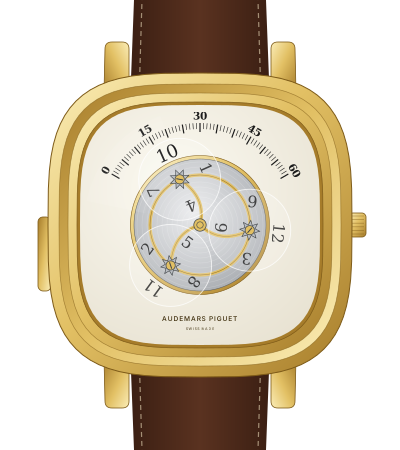
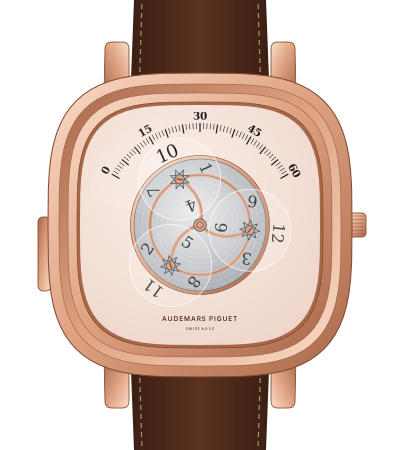
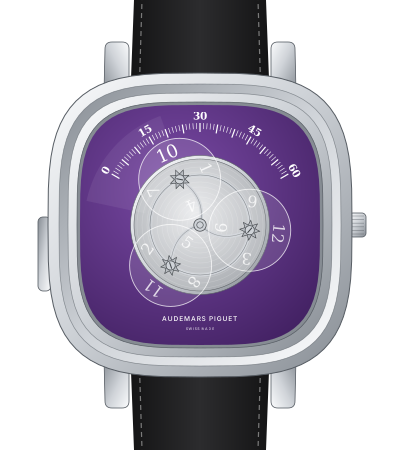
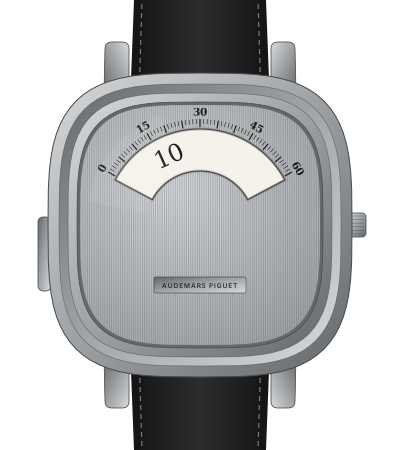
The cushion case has its own story. John W. Shaeffer, an executive of the Allied Chemical and Dye Corporation, owned an early AP minute repeater in a cushion-shaped case and had the manufacture replace its twelve hour markers with the twelve letters of his name. When AP put that watch on show in its museum in 1992, the reaction persuaded it to build a small collection around the shape.5, 18 (Sources differ on the start: A Collected Man dates the John Shaeffer collection to 1995, while Jack Forster dates the modern John Shaeffer minute repeater to 1992.5, 6)
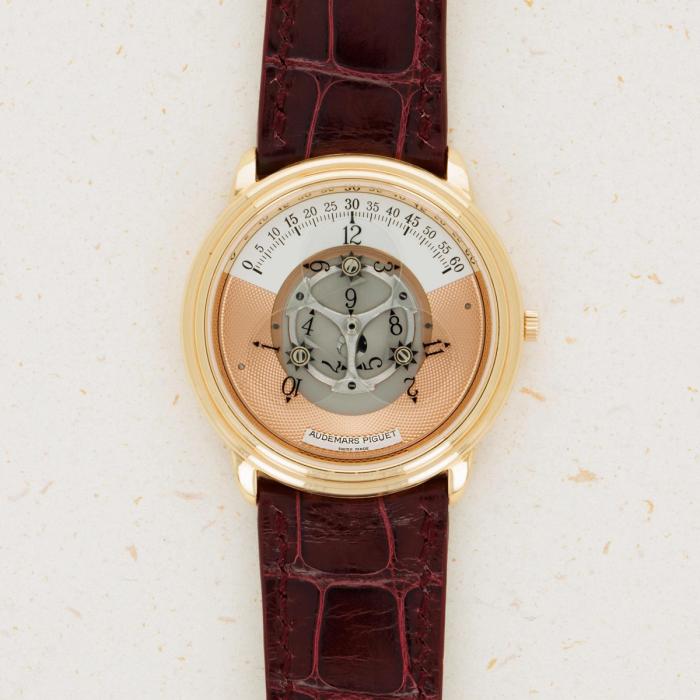
The Star Wheel version is reference 25881, the Répétition Minutes Star Wheel: a 33.5mm cushion in precious metal, the repeater slide on the left flank, and the hand-wound cal. 2867 visible through the back — 32 jewels in the Sotheby's and Phillips catalogues, 34 in Analog:Shift's.15, 16, 18 The dials drop the guilloché for plain, smooth surfaces, and the carrier is made in the same metal as the case.5 Wandering hours and a minute repeater in a 33mm watch is, by any standard, a lot of watchmaking per millimetre.
How many? This is the one Star Wheel where AP has published a figure. The heritage caption for its own yellow-gold example reads model 25881, 17 units, of which seven are pink gold.3 The platinum watches are individually numbered out of ten.15, 16 Whether AP's seventeen includes those ten is not clear from the caption; if it does not, the total is 27. One dealer describes the pink-gold watch as a series of 25,17 which cannot be squared with AP's seven — we would go with AP. The closed-dial watches are rarer still, with three in titanium.5, 18
Millenary Star Wheel
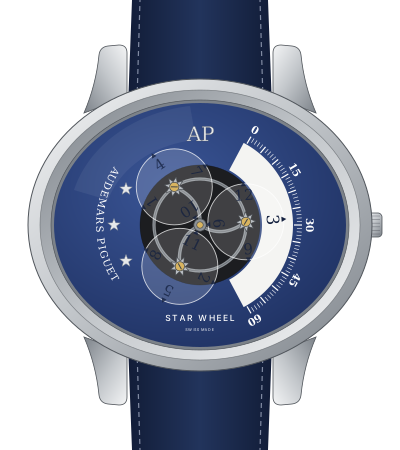
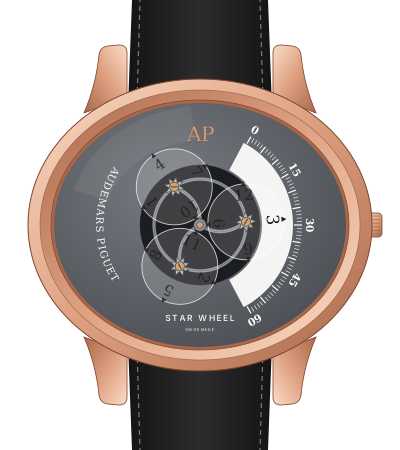
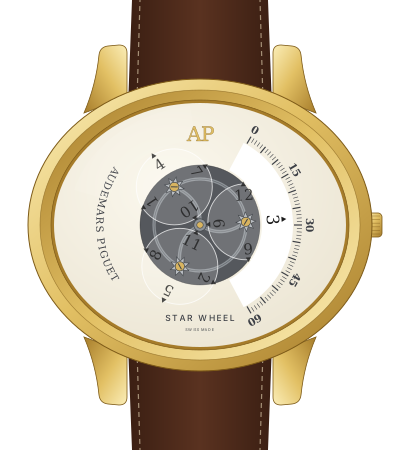
In 2000 Audemars Piguet turned 125, and the Star Wheel came back as one of the anniversary pieces: 250 watches in the horizontal-oval Millenary case — 125 in steel, 75 in pink gold and 50 in yellow gold.5, 19 It is the only Star Wheel in steel. Sotheby's gives the steel watch's full reference as 25898ST/O/0020VE/01;20 the yellow-gold suffix BA follows AP's usual convention, though we have not seen it in a catalogue.
Fitting the display into an oval meant turning it on its side. The minute arc moved from the top of the dial to the right, between one and five o'clock; the AP name went to the left; and for the first time the words “Star Wheel” were printed on the dial, at six.5 The guilloché went, replaced by flat colour. Inside is cal. 2224/2811 — the faster-beating successor to the 2124, at 28,800 vph, which Monochrome's review credits with 35 jewels in the base movement and a 35-hour reserve — behind a closed, screwed back.19 Dealer and auction listings put the case at about 41 by 37mm.
Pocket watches
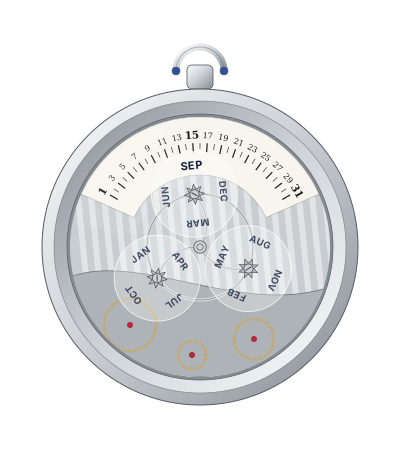
AP's count of thirty models includes pocket watches,27 and two references are documented. Ref. 25913, the Star Wheel “Two Faces”, belongs to the same 125th-anniversary year: a 48mm platinum pocket watch with a conventional blue enamel dial on the front and, on the back, a star-wheel calendar — the arc divided into 31 days, the three sapphire discs carrying four months each, the rest of the dial open to the movement.5 Because the discs turn once a day rather than once an hour, it is also the gentlest use of the mechanism. A UK dealer has listed one as ref. 25913PT/000.21
Ref. 25743 is a platinum pocket watch built around the same mechanism; the same dealer lists it as 25743PT/000, and its reference number — a few digits on from 25720 — points to the early 1990s. That is nearly everything in print about it.21 A Collected Man notes pocket Star Wheels from the 1991–96 run and says, candidly, that it could find almost nothing on them.5 Nor could we.
Code 11.59 Starwheel
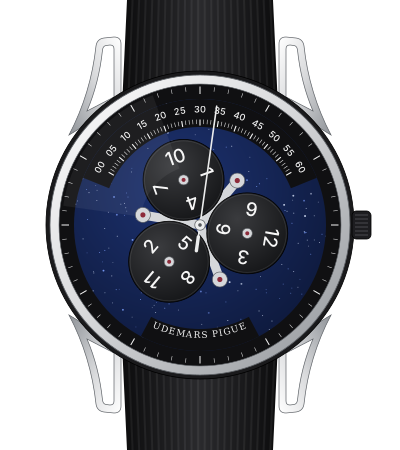
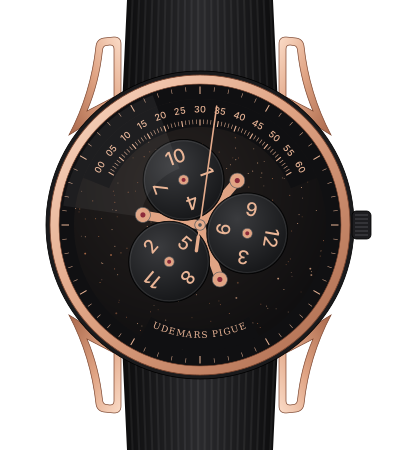
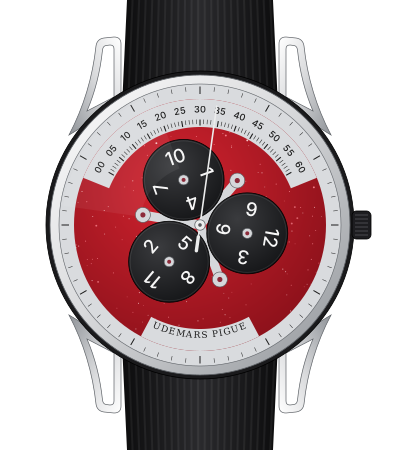
On 1 December 2022, with no warning and nineteen years after the last of the old family, AP announced a new wandering-hours watch in the Code 11.59 case — and closed up the name to one word, Starwheel.23, 24
| Ref. 25720 (1991) | Ref. 15212NB (2022) | |
|---|---|---|
| Case | 36mm × 9mm, gold or platinum | 41mm × 10.7mm; white-gold bezel, lugs and back, black ceramic middle and crown; 30m2, 23 |
| Hour discs | Transparent sapphire, printed numerals | Aluminium, black PVD with an opaline sandblasted finish2 |
| Dial | Engine-turned or engraved gold, white sector | Blue aventurine; minutes on a black inner bezel |
| Seconds | None | Central seconds hand, its tip curved to clear the discs1 |
| Movement | Cal. 2124 + module; 21,600 vph; about 50 hours | Cal. 4310 (cal. 4309 + module); 261 parts, 32 jewels, 28,800 vph, 70 hours23 |
| Launch price | — | CHF 48,000; US$57,900 before tax23, 24 |
| Production | Small; never published | Regular production, not limited24 |
The principle is unchanged — a carrier turning once in three hours, three discs of four numerals, a 120-degree arc1 — but the execution is not a reissue. The discs are opaque, so the theatre of seeing through the display is traded for legibility, and SJX's hands-on review notes that they are driven by finer-toothed wheels than the big eight-pointed stars of 1991.24
A second reference followed in 2025: 15212NR, in pink gold with a black ceramic middle, a black aventurine dial and pink-gold-toned centre wheel and numerals.25 It was not yet in the range when Gear Patrol wrote, early that August, that the white-gold watch was still the only Starwheel reference.26 The occasion for that article was the third modern Starwheel — the SG60 pièce unique, made for Singapore's sixtieth year of independence with a red lacquer dial, silvered rings and an openworked pink-gold rotor. It sold at a National Museum of Singapore charity dinner on 15 August 2025 for S$480,000, against a local retail price of S$92,110 for the standard watch.24
Every reference in one table
| Reference | Model & case | Dials recorded | Calibre | Dated | Made |
|---|---|---|---|---|---|
| 25720BA | Star Wheel 36mm yellow gold | Gold guilloché; hand-engraved; tiger's eye | 2124 + module | 1991 launch; c.1993 example | Not published |
| 25720PT | Star Wheel 36mm platinum | White-gold guilloché; engraved; blue; burgundy/purple; pink copper | 2124/2812 | 1991 launch; 1992, c.1997, c.1998 examples | Not published |
| 25720OR | Star Wheel 36mm pink gold | Pink-gold guilloché; hand-engraved | 2124 + module | After launch; 1994 and 1999 examples | Not published |
| 25720BC | Star Wheel 36mm white gold | White-gold guilloché | 2124 + module | — | Not published; existence lightly documented |
| 25720 (gem-set) | Star Wheel 36mm, diamond bezel | As above | 2124 + module | 1990s | Fewer than five |
| 25746OR | Star Wheel, openworked 36mm pink gold, diamond bezel | Engraved skeletonised | 2124/2812 | — | Unknown; single dealer report |
| Pièces uniques | Star Wheel Automatic 38mm platinum, 36 baguette emeralds / rubies | Mother-of-pearl sector, pavé | 2124 | c.1995–2000 | 1 + 1 |
| 25743PT | Star Wheel pocket watch Platinum | — | — | 1990s | Unknown |
| 25881BA / OR | John Shaeffer Répétition Minutes Star Wheel 33.5mm cushion, yellow or pink gold | Plain silvered / rose-toned | 2867, hand-wound | From 1995 | 17 units incl. 7 pink gold (AP) |
| 25881PT | John Shaeffer Répétition Minutes Star Wheel 33.5mm cushion, platinum | Purple | 2867 | c.1995 | Numbered edition of 10 |
| — (closed dial) | John Shaeffer Répétition Minutes Star Wheel Cushion, titanium (and precious metals) | Brushed closed dial, window 10–2 | 2867 | 1996 | 3 in titanium |
| 25898ST | Millenary Star Wheel Oval, c.41 × 37mm, steel | Blue, three stars | 2224/2811 | 2000 | 125 |
| 25898OR | Millenary Star Wheel Oval, pink gold | Grey | 2224/2811 | 2000 | 75 |
| 25898BA | Millenary Star Wheel Oval, yellow gold | Eggshell | 2224/2811 | 2000 | 50 |
| 25913PT | Star Wheel Two Faces pocket watch 48mm platinum | Blue enamel front; star-wheel calendar back | — | 2000 | Unknown |
| 15212NB .OO.A002KB.01 | Code 11.59 Starwheel 41mm white gold / black ceramic | Blue aventurine | 4310 | Dec 2022 → | Regular production |
| 15212NR .OO.A002KB.01 | Code 11.59 Starwheel 41mm pink gold / black ceramic | Black aventurine | 4310 | 2025 → | Regular production |
| Starwheel SG60 | Code 11.59 Starwheel 41mm white gold / black ceramic | Red lacquer | 4310 | Aug 2025 | 1 |
That is eighteen lines, and AP counts around thirty models. The gap is real. Each metal-and-dial pairing of the 25720 probably counts as a model in AP's arithmetic, as would the undocumented pocket watches and closed-dial John Shaeffers in other metals — but that is our inference, not AP's statement. If you own or have handled a Star Wheel that is not on this list, we would like to hear about it.
Production numbers
What has actually been published:
| Watch | Number | Who says so |
|---|---|---|
| All Star Wheel models, 1991–2003 | Around 30 models (not pieces) | Audemars Piguet2 |
| John Shaeffer ref. 25881 | 17 units, seven of them pink gold | Audemars Piguet Heritage3 |
| Ref. 25881 platinum, purple dial | 10, individually numbered | Sotheby's, Phillips, Christie's15, 16 |
| John Shaeffer closed dial, titanium | 3 | Analog:Shift; A Collected Man5, 18 |
| Millenary Star Wheel ref. 25898 | 250: 125 steel, 75 pink gold, 50 yellow gold | Monochrome; A Collected Man; Sotheby's5, 19, 20 |
| Ref. 25720 with gem-set bezel | Fewer than five | A Collected Man; Hairspring5, 8 |
| Platinum 38mm emerald and ruby watches | One of each | Antiquorum13 |
| Code 11.59 Starwheel SG60 | 1 | SJX24 |
| Ref. 25720, all metals | Never published | — |
The honest answer on the 25720 is that nobody outside Le Brassus knows, and anyone quoting a figure should be asked where it came from. We found none in AP's material, in any auction catalogue, or in the specialist press; the most any of them commit to is that it was made in very small numbers and in precious metals only.5, 17 Serial numbers do not help: AP's case and movement numbers run across the whole production, not per reference, so the D-prefixed case numbers on Star Wheels say when a watch was cased, not how many siblings it has.
What the record does support is a ranking. Yellow gold is the metal you will actually find. Platinum is markedly scarcer and brings multiples of the price. Pink gold arrived later and sits between them. White gold is so thinly documented that any example deserves a close look at its hallmarks. Within each metal the engraved dial is rarer than the engine-turned one, and coloured and stone dials are rarer again — a handful each.5, 8
For scale, AP's heritage site records that the manufacture took 14,650 cal. 2124 blanks from LeCoultre between 1983 and 1996, and that 6,866 of them went into Royal Oaks.4 The Star Wheel had to share what was left with every other 2124-based dress watch AP made for thirteen years. That sets a ceiling, not an estimate — but it is a low ceiling.
What they sell for
| Date | Sale | Watch | Result |
|---|---|---|---|
| May 2019 | Phillips, Geneva Watch Auction: Nine, lot 42 | 25720PT, pink-copper dial, c.1997 | CHF 35,000 (est. 7,000–9,000)9 |
| 5 Dec 2021 | Antiquorum, Hong Kong, lot 161 | Platinum pièce unique, emeralds | HKD 1,375,000 (est. 400,000–800,000)13 |
| 5 Dec 2021 | Antiquorum, Hong Kong, lot 377 | Platinum pièce unique, rubies | HKD 1,000,000 (est. 400,000–800,000)13 |
| 7 May 2022 | Antiquorum, Geneva | 25720 platinum, “tropical purple” dial, c.1998 | Est. CHF 40,000–60,00014 |
| May 2024 | Sotheby's, London, Fine Watches, lot 5 | 25881 platinum, purple dial, No. 9/10 | £108,000 reported (est. 70,000–100,000)15 |
| Nov 2024 | Phillips, Geneva, Reloaded, lot 6 | 25881 platinum, purple dial, No. 5/10 | CHF 106,680 (est. 25,000–50,000)16 |
| Nov 2024 | Sotheby's, Geneva, Important Watches I, lot 97 | 25720 platinum, c.1997 | Est. CHF 22,000–45,00010 |
| Apr 2025 | Sotheby's, AREA_51, lot 36 | 25720OR, made 1994 | Est. CHF 20,000–40,00011 |
| 15 Aug 2025 | National Museum of Singapore charity dinner | Code 11.59 Starwheel SG60, unique | S$480,00024 |
The direction of travel is not subtle. A Collected Man records a yellow-gold 25720 selling for about £6,200 at auction in 2018 and a comparable one for £20,000 two years later.5 The Phillips platinum watch in 2019 went for roughly four times its high estimate; by 2024 Sotheby's was estimating the same reference at CHF 22,000–45,000 before the bidding started. Hairspring's notes from early 2024 record coloured-dial platinum watches changing hands between the low 60,000s and the mid 90,000s.8 The arrival of the Code 11.59 Starwheel has, if anything, sent more people looking for the original. None of this is advice; see our disclaimer.
Buying notes
- Match the calibre to the watch. A 25720 should have cal. 2124; the Millenary has cal. 2224. Dealer descriptions routinely swap them, and occasionally the text has been pasted from another listing altogether. Read the movement, not the copy.
- Ask for an Extract from the Archives — and ask what dial it records. On a platinum watch with a burgundy, purple or copper dial this is the whole question.
- The discs are the watch. Look for scratches, hazing and re-printed numerals on the sapphire. Watch an hour change if you can: the outgoing disc should snap cleanly and the incoming numeral should sit square to the scale.
- Stepped bezels do not survive polishing well. The two steps should be crisp and the lugs should keep their down-turned edge. Hallmarks sit on the case flank or between the lugs.5
- Yellow gold is the way in; platinum is the prize. Pink gold sits between them, and an engraved dial adds rarity in any metal.
- The Millenary has a closed back,19 so you cannot inspect the movement without opening it — buy the seller.
- The John Shaeffer is a minute repeater first. Listen to it: even, clear strikes matter more than anything on the dial.
- The Code 11.59 Starwheel is not limited.24 Pay accordingly.
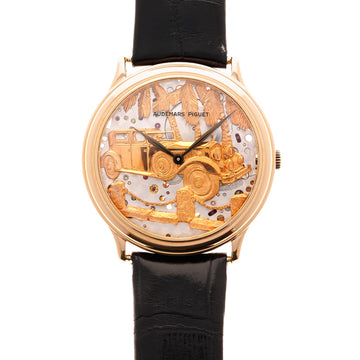
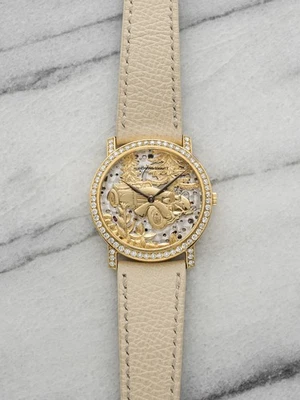
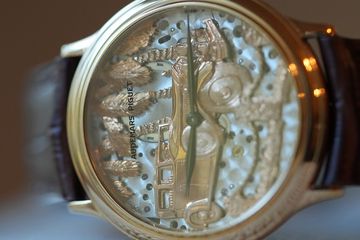
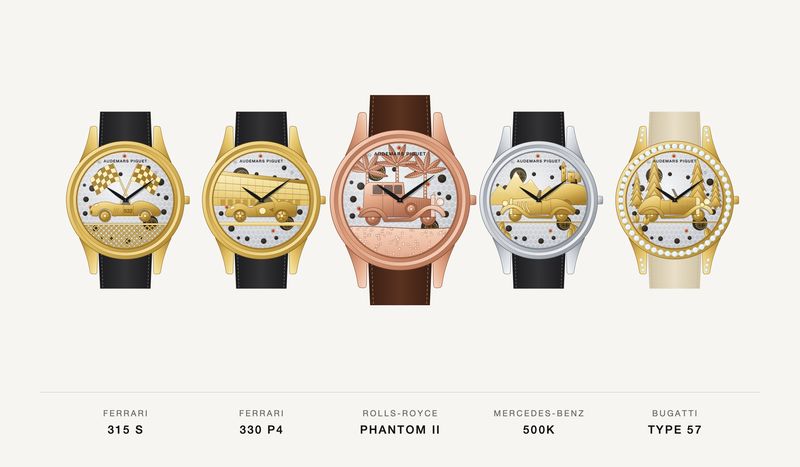
Keep reading. For the wider family tree — Urwerk, Vacheron Constantin, H. Moser and everyone else who has built a wandering-hours watch — see our guide to star wheel watches from every maker. And if this quieter side of 1990s Audemars Piguet appeals, the same years produced the hand-engraved skeleton car watches of ref. 14677, one of which — the Ferrari 315 S tribute, ref. 14677BA — we have written up separately.
Sources
- Audemars Piguet, “Starwheel and the wandering hours” — mechanism description and statement by Sébastian Vivas, Heritage and Museum Director.
- Audemars Piguet press release, “Code 11.59 by Audemars Piguet Starwheel revisits the tradition of wandering hours”, December 2022, as republished by Luxferity.
- AP Chronicles (Audemars Piguet Heritage), “The epic AP saga” — captions for the 1992 Star Wheel model 25720 (Inv. 2120) and the 1995 John Shaeffer model 25881 (Inv. 578).
- AP Chronicles, “Calibre 2124”.
- Raj Chaudhuri, “The story of the Audemars Piguet Star Wheel”, A Collected Man, May 2022. The fullest history in print, written with the AP archives and the collectors Tom Chng and @ciaca1970.
- Jack Forster, “Jack's Pick of the Week: the Audemars Piguet Star Wheel”, The 1916 Company.
- European Watch Company, “Wandering but Not Lost: The Audemars Piguet Star Wheel Reference 25720BA”.
- Hairspring, “Burgundy Dial 25720PT Audemars Piguet Star Wheel”, 7 January 2024.
- Phillips, The Geneva Watch Auction: Nine, May 2019, lot 42 — ref. 25720PT, case D8239, movement 368'539.
- Sotheby's Geneva, Important Watches: Part I, November 2024, lot 97 — platinum ref. 25720, case D8'277.
- Sotheby's, AREA_51, April 2025, lot 36 — ref. 25720OR.OO.0002XX.04, made in 1994, case D25'812.
- Loupe This, ref. 25720/002OR with 1999 guarantee and ref. 25720BA with engraved dial.
- Antiquorum, Important Modern & Vintage Timepieces & Jewels, Hong Kong, 5 December 2021, lot 161 (emeralds) and lot 377 (rubies).
- Antiquorum Geneva, 7 May 2022 — ref. 25720, platinum, “tropical purple dial”, via Invaluable.
- Sotheby's London, Fine Watches, May 2024, lot 5 — ref. 25881, platinum, No. 9 of 10. Christie's has separately sold No. 3 of 10.
- Phillips Geneva, Reloaded: The Rebirth of Mechanical Watchmaking, 1980–1999, November 2024, lot 6 — ref. 25881, platinum, No. 5 of 10, case D71823.
- The Keystone, John Shaeffer Star Wheel Minute Repeater ref. 25881OR and “Model Profile: Audemars Piguet Star Wheel Ref. 25720”.
- Analog:Shift, Audemars Piguet Répétition Minutes ‘John Schaeffer’ — titanium, closed dial, 1996.
- Frank Geelen, Monochrome Watches, “Audemars Piguet Millenary Star Wheel reviewed”, 29 August 2011, and “Weekly Watch Photo”, 9 May 2011.
- Sotheby's, Millenary Star Wheel, Reference 25898ST/O/0020VE/01.
- Almar Watches, London — ref. 25913PT/000 and ref. 25743PT/000.
- TimeTells, Audemars Piguet Star Wheel 25746OR. Single dealer source; not corroborated by AP or an auction catalogue.
- Monochrome Watches, “Audemars Piguet Brings Back The Starwheel Concept, Within Code 11.59”, 1 December 2022, and hands-on, 13 December 2022.
- SJX Watches, “Up Close: Audemars Piguet Code 11.59 Starwheel”, 3 January 2023, and “A Unique Audemars Piguet Code 11.59 Starwheel”, 29 July 2025, updated with the sale result.
- Audemars Piguet product pages: 15212NB.OO.A002KB.01 and 15212NR.OO.A002KB.01.
- Gear Patrol, “The Coolest Audemars Piguet Watch of 2025 Isn't a Royal Oak”, 7 August 2025.
- Jack Forster, “Mass Effect: The Code 11.59 By Audemars Piguet Starwheel”, 5 December 2022.
- Time-Wire, “Star Wheel: History, Specs & References” — reference list including 25720BC and 25720BA.OO.A002XX.01.
- Photograph of ref. 25720BA: “Star Wheel.jpg” by jcw, Wikimedia Commons, CC BY 3.0. All other images are original Watchphile illustrations, generated by
scripts/ap-starwheel-illustrations.js.
Researched September 2026. Corrections and additions are welcome — this page is meant to be kept current.