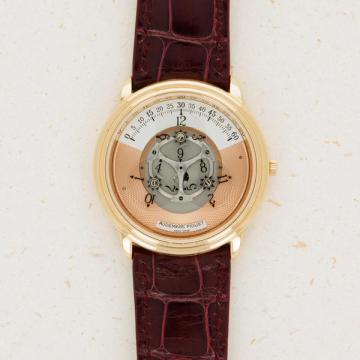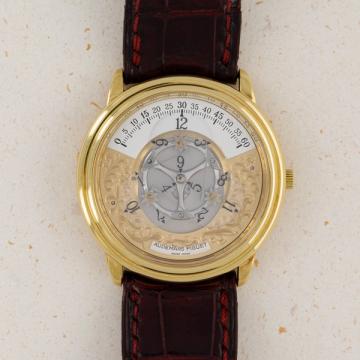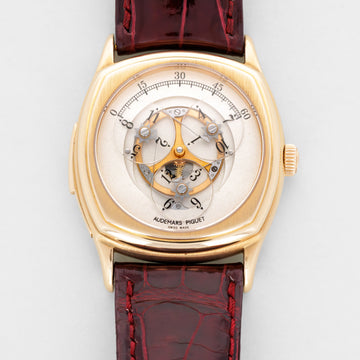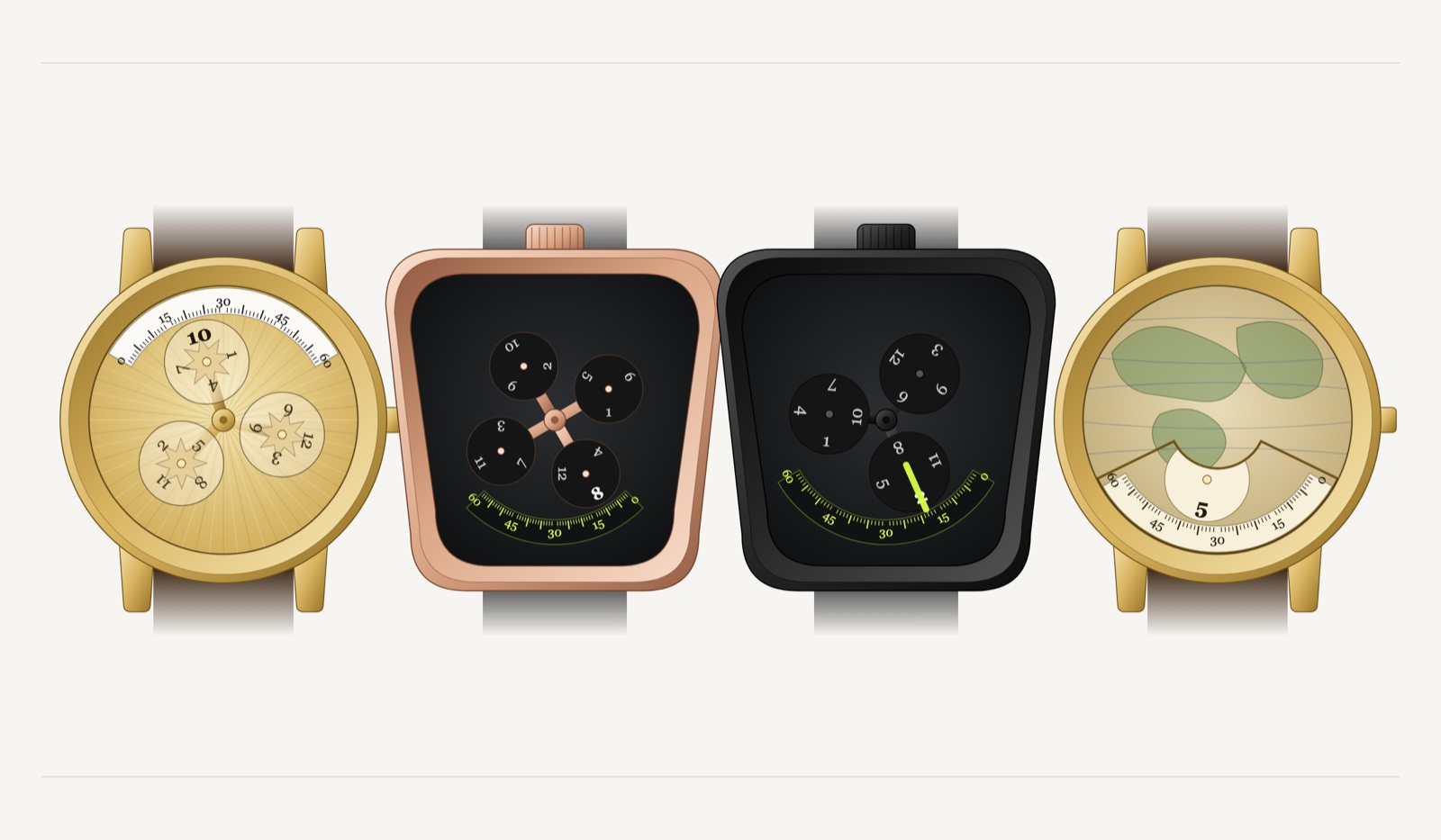
A star wheel watch has no hands. The hour is a numeral that travels across the dial, and wherever it happens to be along a curved minute scale is the time. Watchmakers call the display wandering hours — heures vagabondes in French, satellite hours in Urwerk's vocabulary — and it is one of the oldest alternative ways of showing time still in production. It was invented for a pope in the 1650s, forgotten twice, and brought to the wrist by Audemars Piguet in 1991 under the name that stuck with collectors: the Star Wheel.
This page is a census. It lists every maker we could verify that has put a true wandering-hours display into a wristwatch, the major models and dial variants of each, the reference numbers, the production years, and either the published edition size or the best available production estimate. Where the record is thin we say so, and where sources disagree we show both figures. Commonly repeated mistakes — a steel ref. 25720, a “ref. 25798 Star Wheel,” a Miyota-powered Gorilla Drift — are flagged where they come up.
- Also called
- Wandering hours, satellite hours, heures vagabondes; marketed today as floating or flying hours
- Invented
- Rome, c. 1655–56 — the Campani brothers' silent night clock for Pope Alexander VII
- First serially made wristwatch
- Audemars Piguet Star Wheel ref. 25720, launched 1991
- Most prolific maker
- Urwerk — more than twenty satellite-hour families since 1997, roughly 150 watches a year in total
- Classic geometry
- Three satellites × four numerals, one turn of the carrier every three hours, 120° minute arc
- Other geometries
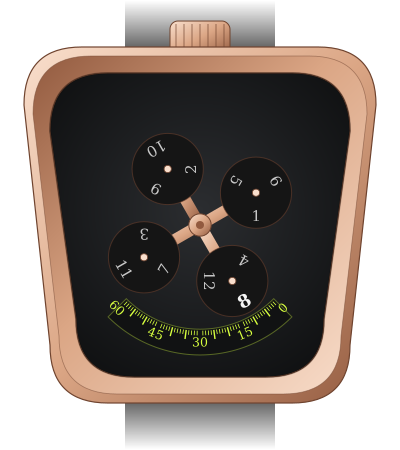
- Four satellites × three numerals (90° arc); two × six (180°); cubes and prisms with retrograde minute hands; 240° arc (Urwerk UR-150)
- Price of entry, 2026
- About US$400–1,300 (Hong Kong and US microbrands); US$3,250 Swiss-made (Gorilla); CHF 38,000 for the cheapest new Urwerk
- Top of the market
- CHF 480,000 — De Bethune × Urwerk Moon Satellite (unique), June 2026
How a star wheel display works
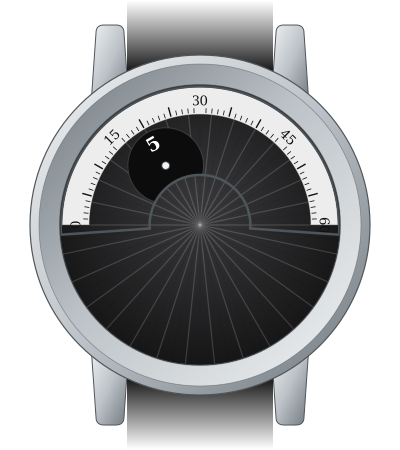
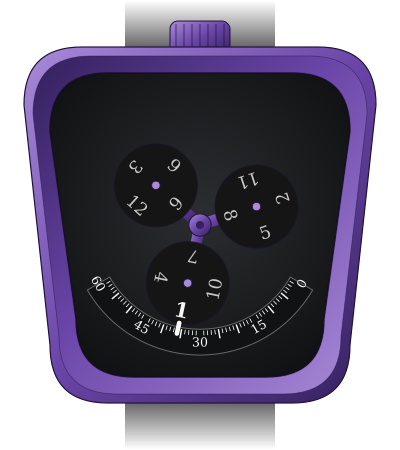
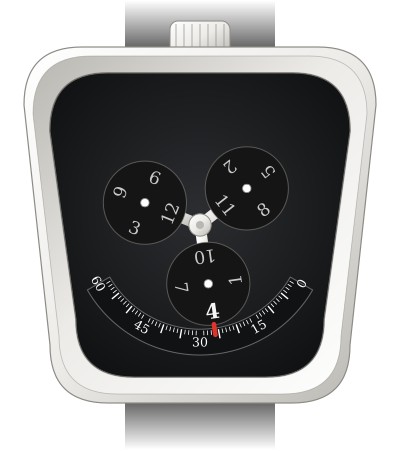
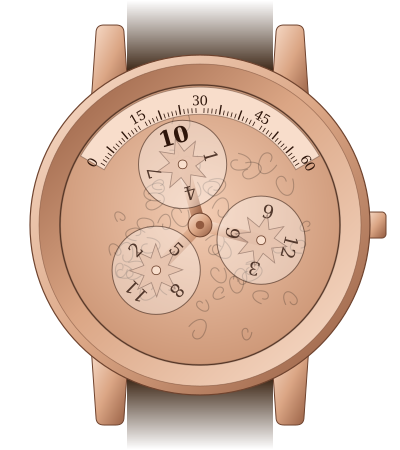
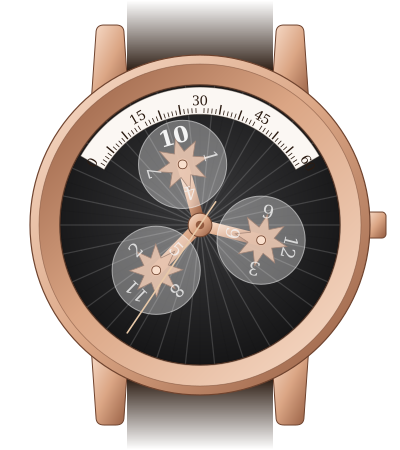
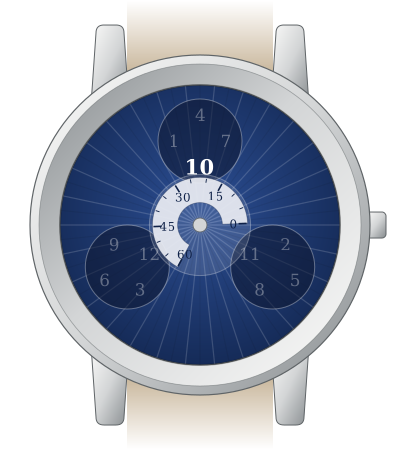
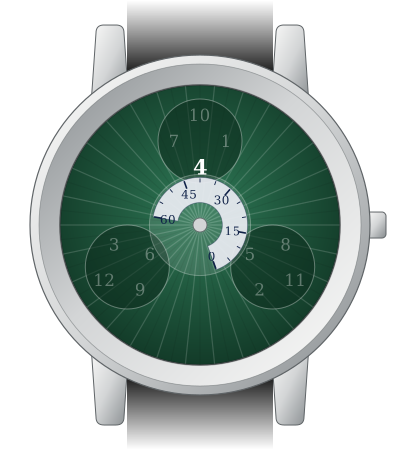
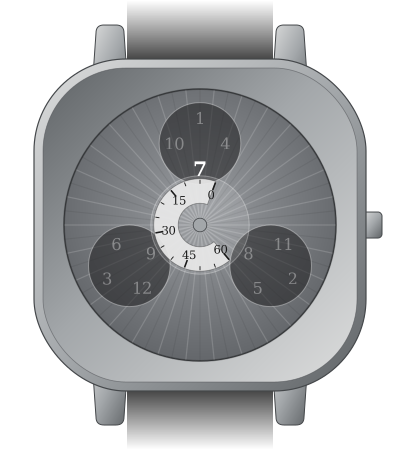
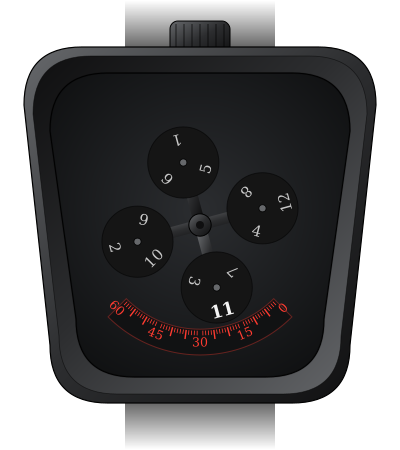
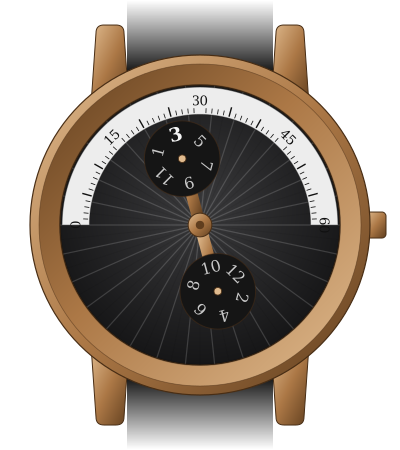
Every wandering-hours watch is a variation on one idea. A carrier sits on the centre axis and turns slowly. It holds a number of satellites spaced evenly around it, each printed with a share of the twelve hour numerals. Only one sector of the dial is open and marked from 0 to 60. The satellite crossing that sector shows the hour, and its position along the scale shows the minutes; as it leaves at 60 the next satellite enters at 0. While a satellite is out of sight on the far side of the dial it is turned by one numeral, so that it comes round again showing the right hour.
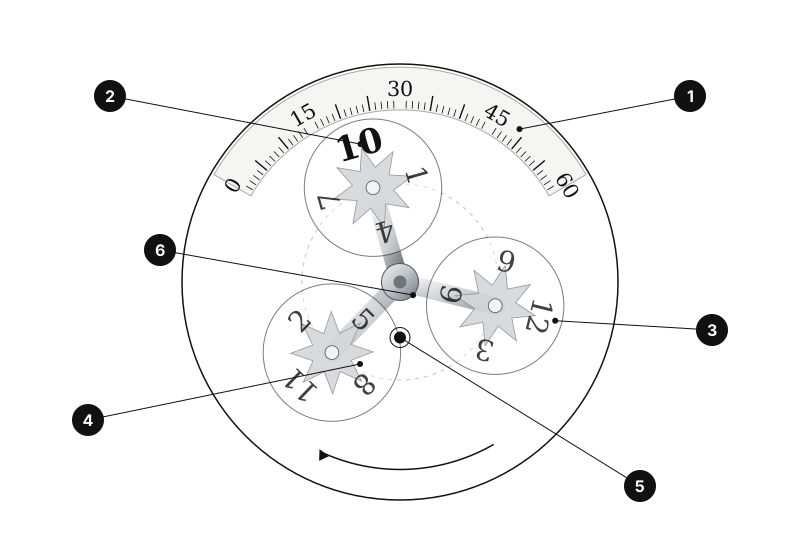
Because twelve divides by two, three and four, those are the practical numbers of satellites, and each gives a different watch:
| Layout | Carrier turns once every | Minute arc | Numerals per satellite | Index step per lap | Found on |
|---|---|---|---|---|---|
| 2 satellites | 2 hours | 180° | 6 (odd hours / even hours) | 60° | Campani night clocks; watches c. 1700; Urwerk UR-101; Titan Stellar; DWISS S1 |
| 3 satellites | 3 hours | 120° | 4 (1-4-7-10 / 2-5-8-11 / 3-6-9-12) | 90° | AP Star Wheel; Vacheron Constantin; Parmigiani; Arnold & Son; most Urwerks; Gorilla; Xeric |
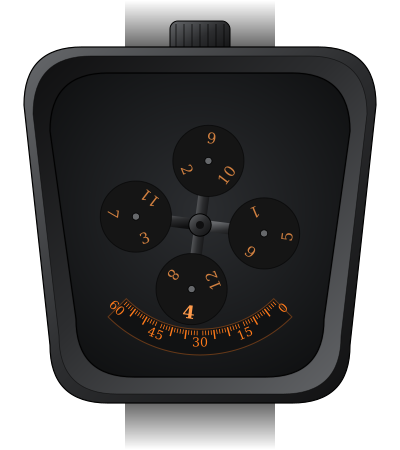
| 4 satellites | 4 hours | 90° | 3 (1-5-9 / 2-6-10 / 3-7-11 / 4-8-12) | 120° | Urwerk UR-103 and UR-105; Atowak Ettore Drift |
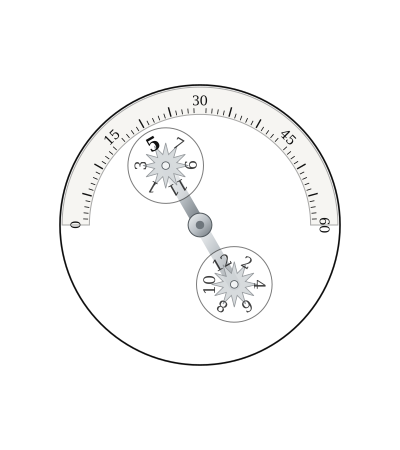
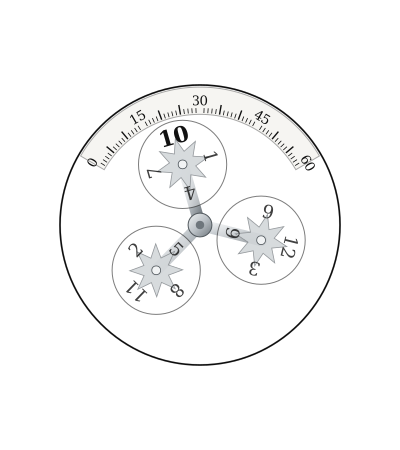
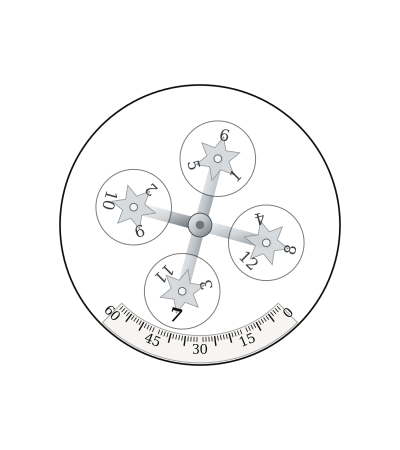
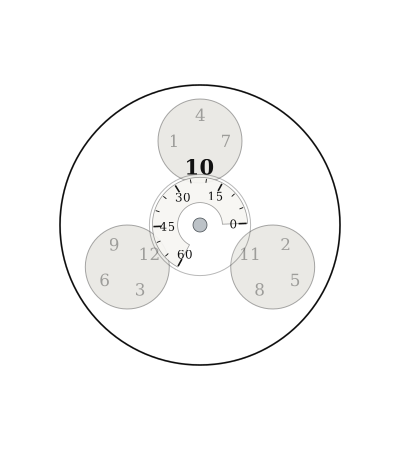
Two ways of indexing the satellites divide the field. Star wheel and jumper — AP's 1991 solution, and the older one — has a fixed pin push a point of the star until a sprung jumper snaps it into the next notch; on the Star Wheel the disc makes its quarter-turn in two 45° clicks. It is simple and tolerant, but lifting the jumper costs a little torque every time. The Geneva (Maltese) cross used by Urwerk, Vacheron Constantin and Parmigiani drags the satellite round positively, with no spring to fight. Either way the change happens out of sight and can be slow and gentle, which is the display's real advantage over a jump hour: nothing has to store energy for an instantaneous snap.
The hour numeral is not kept upright. It is locked to the carrier as it crosses the arc, so on a 120° scale it leans about 60° one way at :00, stands straight at :30 and leans the other way at :60. Only a few designs — Urwerk's UR-110, UR-T8 and UR-120, Atowak's Cosmofleet — add planetary gearing to hold the numeral level.
Later inventions build on the same carrier. Urwerk added a retrograde minute hand that frames the active satellite (Opus V, UR-210, UR-220, UR-230) and, on the UR-150, stretched the arc to 240° with a cam, rack and planetary train. Hautlence and H. Moser & Cie inverted the whole thing: three hour discs stay fixed at 120° intervals while a transparent minute sector wanders past them. A readout is coarse by nature — the pointer moves 1.5° to 3° a minute against a normal minute hand's 6° — and that is the trade every one of these watches makes for being readable in a single glance.
From a pope's night clock to the wrist
Rome, 1655–56. Fabio Chigi became Pope Alexander VII in April 1655. He slept badly, disliked the ticking of a bedside clock and did not want a lamp glaring in front of a dial, and in October 1655 he asked his majordomo for a clock that was silent and readable in the dark. The three Campani brothers — Matteo, a priest and mechanician; Pier Tommaso, a clockmaker; and Giuseppe, later Europe's finest telescope maker — delivered it in 1656. It held two inventions: a silent crank escapement, and a back-lit wandering-hours dial. An oil lamp inside the altar-shaped case shone through pierced numerals; the hour rose at the left of a semicircular slot, crossed it in sixty minutes and set at the right as the next appeared. Behind the painted dial a large disc turned once every two hours, carrying two smaller discs — odd hours and even hours — each nudged on by a fixed finger while hidden. It is the Star Wheel's mechanism in every respect but the numbers: two satellites and 180° instead of three and 120°. The Pope rewarded the brothers with a privilege, an early form of patent. (AP dates the invention 1655, most writers 1656; both are fair.)
The fashion spreads. Night clocks reached England within a decade — on 24 June 1664 Samuel Pepys saw one in the Queen's bedchamber at Whitehall, “her clock by her bed-side, wherein a lamp burns that tells her the time of the night at any time” — and were made by the Fromanteels, Joseph Knibb, Edward East and others, as well as in Augsburg and Florence. They faded around 1710, undone by repeating work and the chore of keeping a lamp trimmed all night.
Watches, c. 1680–1730. The balance spring of the mid-1670s made watches accurate enough to be worth showing minutes, and for a generation nobody had settled how. English makers tried six-hour dials, differential dials, sun-and-moon dials and the wandering-hour dial: a semicircular slot across the top of a silver champlevé dial, a minute scale around its edge, and a single hour numeral travelling through it. The lower half was free for decoration, which is why so many carry royal arms or a portrait — William III, Queen Anne, Frederick I of Prussia — and were given as presentation pieces. Makers recorded on surviving examples include Gordon Sinclare of Dublin (c. 1690, the earliest museum-dated one we found), Peter Garon, Henry Massy, John Bushman and Joseph Antram in London, Estienne Boisson in Geneva and a string of German workshops.


The nineteenth century. Around 1820 a group of large eight-day Swiss watches appeared with a gold mask of Chronos for a dial and blued-steel hour numerals travelling through a white enamel minute segment; they are signed Breguet et Fils (as établissement mixte, made outside the workshop), Dubois et Fils, or not at all. By then the sector had narrowed towards 120°. Audemars Piguet's own heritage collection holds one by Vaucher Frères of about 1820, alongside a wandering-hours piece of about 1700 by Christian Beeg. A Perrin Frères pocket watch of the same era, now in the Sandoz collection, would become the model for Parmigiani's Toric Capitole two centuries later. Around 1900 the idea survived as a cheap Roskopf-movement souvenir — the British Museum has one with a portrait of Pope Pius X.
The Art Deco red herring. Auction catalogues often describe 1920s and 1930s Breguet, Vacheron & Constantin and Gübelin dress watches as “wandering hours.” Nearly all use modules by Robert Cart of Le Locle, sold under the name Chronoscope (Swiss patent CH 130191, filed 27 January 1928), and they are really jump-hour watches: either the hour jumps in a fixed window while a jewel orbits the minute ring, or a single jumping hour window travels a full circle once an hour at the tip of an arrow. The second type is a genuine cousin — Vincent Calabrese's Baladin and F. P. Journe's Vagabondage descend from it — but neither has satellites or a minute arc. “Chronoscope” is Cart's trade name, not a synonym for wandering hours.
The gap. We found no verifiable true wandering-hours wristwatch made between the 1930s and 1991. Which is why what happened in Le Brassus that year counts as a revival rather than a continuation.
| Year | Event |
|---|---|
| 1655–56 | Campani brothers build the silent, lamp-lit night clock for Pope Alexander VII |
| 1664 | Pepys records a night clock at the English court |
| c. 1690–1715 | Wandering-hour pocket watches in London, Dublin, Geneva and Germany |
| c. 1820 | Eight-day “Chronos” wandering-hours watches signed Breguet et Fils and others |
| 1928 | Robert Cart patents the Chronoscope — a jump-hour cousin, often mislabelled |
| 1904 | The Journal suisse d'horlogerie publishes “Une montre originale,” on an 1820s wandering-hours watch |
| 1989 | AP technical director Serge Meylan, having found that article, completes the Star Wheel drawing on 13 September |
| 1991 | Audemars Piguet Star Wheel ref. 25720 — first serially produced wandering-hours wristwatch |
| 1997 | Urwerk shows the UR-101 and UR-102 at Basel |
| 2000 | AP Millenary Star Wheel, 250 pieces for the 125th anniversary |
| 2003 | Urwerk UR-103; last first-generation AP Star Wheel |
| 2004 | Vacheron Constantin Métiers d'Art Tribute to Great Explorers |
| 2005 | Harry Winston Opus V by Felix Baumgartner: cube satellites and a retrograde minute hand |
| 2011 | Urwerk UR-110 wins the GPHG design prize; Parmigiani Toric Capitole |
| 2015 | Arnold & Son Golden Wheel |
| 2018 | Gorilla Fastback Drift brings the price under CHF 3,000; H. Moser Endeavour Flying Hours |
| 2022 | AP Code 11.59 Starwheel ends a nineteen-year gap |
| 2024 | Urwerk UR-150 Scorpion: 240° retrograde arc |
| 2025 | Ulysse Nardin × Urwerk UR-FREAK; Titan builds India's first; Ōtsuka Lōtec No.5 KAI in Japan |
Every maker at a glance
| Maker | Wandering-hours models | Years | Layout | Documented or estimated production | New price band |
|---|---|---|---|---|---|
| Audemars Piguet | Star Wheel ref. 25720; pocket watches 25743, 25913; John Shaeffer repeaters 25797, 25881; Millenary 25898 | 1991–2003 | 3 × 4, 120° at top (right on the Millenary) | 25720: unpublished — evidence points to hundreds, not thousands. Others: 12 + 17 + 250 + 25 | Last list £11,450; now CHF 20,000–100,000+ |
| Audemars Piguet | Code 11.59 Starwheel 15212NB, 15212NR, SG60 | 2022– | 3 × 4, 120°, centre seconds | Undisclosed; boutique only | CHF 48,000 at launch |
| Urwerk | UR-101, UR-102 | 1997–c. 2003 | 2 × 6, 180° window | Tens of watches | — |
| Urwerk | UR-103 | 2003–10 | 4 × 3, bottom arc | c. 400 documented; high hundreds plausible | — |
| Harry Winston | Opus V (by Urwerk) | 2005 | 3 cubes × 4, retrograde 120° | 100 | — |
| Urwerk | UR-201, UR-202, UR-203 | 2007–c. 2012 | 3 cubes × 4, telescopic hands | Low hundreds | From US$122,000 |
| Urwerk | UR-110 | 2011–15 | 3 × 4 planetary, arc at right | c. 342 | c. CHF 80,000 |
| Urwerk | UR-210 → UR-220 → UR-230 | 2012–25 | 3 cubes × 4, retrograde 120° | c. 315–370; a few dozen; 105 | CHF 130,000–180,000 |
| Urwerk | UR-105, UR-106 | 2014–21 | 4 × 3 (105); 3 × 4 (106) | c. 750–900; under 100 | CHF 58,000–85,000 |
| Urwerk | UR-T8 | 2017–20 | 3 × 4 planetary, reversible case | 67 | CHF 100,000 |
| Urwerk | UR-100, UR-100V | 2019– | 3 × 4, bottom arc, distance scales | 150 + c. 400 and counting | CHF 48,000–88,000 |
| Urwerk | UR-120; UR-150 | 2022–26; 2024– | Splitting satellites; 240° retrograde | Un-numbered + 20; 175 to date | CHF 88,000–115,000 |
| Urwerk | UR-102 Reloaded; UR-101 T-Rex, Diamond Sky | 2023– | Heritage re-editions | 50 + 100 + 25 | CHF 28,000–85,000 |
| Ulysse Nardin × Urwerk | UR-FREAK | 2025 | 3 satellites on the Freak carousel | 100 | CHF 100,000 |
| Vacheron Constantin | Tribute to Great Explorers (three series), Sputnik, Savoirs Enluminés, Explorer Naturalists, Les Cabinotiers | 2004–25 | 3 arms × 4, Maltese-cross cam, 120° | 388 announced | €100,000–203,000 |
| Parmigiani Fleurier | Toric Capitole minute repeater | 2011–19 | 3 × 4, sector at top | Under ten | CHF 390,000 |
| Arnold & Son | Golden Wheel | 2015–16 | 3 sapphire discs × 4, dead-beat seconds | 125 | CHF 43,300 |
| H. Moser & Cie | Endeavour Flying Hours; Pioneer Flying Hours | 2018–19; 2025– | Inverted: fixed hours, wandering 240° minute sector | 260; open + 100 | CHF 29,000–39,000 |
| Hautlence | HL Vagabonde; Vagabonde Series 4; Vagabonde Tourbillon | 2018– | As Moser | c. 250 announced | CHF 26,900–79,000 |
| Gorilla | Fastback Drift, Outlaw Drift | 2018– | 3 × 4, 120° at top, Vaucher module | c. 1,200 announced | US$2,850–4,850 |
| Ōtsuka Lōtec | No.5 KAI | 2025– | 3 × 4, 120°, instantaneous | Unpublished; Japan lottery | ¥748,000–825,000 |
| DWISS, Titan | RW1, M3W, S1; Stellar 3.0 | 2020– | 3 × 4; 2 × 6 | 500-piece caps | US$2,000–2,900 |
| Xeric, Atowak, Angles, OLTO-8 and others | Eight, seven, seven and two families | 2020– | Mostly 3 × 4 on Miyota | Caps in the thousands; real volumes far lower | US$400–3,800 |
“3 × 4” means three satellites carrying four numerals each. Production figures are sums of announced editions unless marked as an estimate; makers rarely confirm that every run was completed.
Audemars Piguet Star Wheel (1991–2003)
The modern story starts with a magazine. AP's press releases say only that “a watchmaker” found the idea in the Journal suisse d'horlogerie in 1989. The company's own heritage journal is more exact: Serge Meylan, then AP's technical director, came across a piece the journal had published back in 1904 under the heading “Une montre originale,” describing a wandering-hours watch of the 1820s, and he finished the technical drawing of what became the Star Wheel on 13 September 1989. Eighteen months of development and one patent later, AP launched ref. 25720 in 1991: the first serially produced wristwatch with wandering hours, and the watch that gave the whole genre its collector nickname. By AP's own account it “did not achieve the expected success” and left the catalogue about a decade later — which is a large part of why it is collected now.
AP itself hedges on the name — “probably” after the three stars that carry the hour discs — but the mechanical explanation is tidier. Each of the three sapphire discs rides on an eight-toothed star wheel held by a jumper spring. The central carrier turns once every three hours; while a disc is out of sight of the minute sector, fixed pins click its star wheel round by a quarter-turn so the next numeral in its sequence (1-4-7-10, 2-5-8-11 or 3-6-9-12) is facing outward when it arrives back at the 120° minute track between 10 and 2 o'clock.

We keep a separate, much longer guide to this family — every dial, case number cluster and auction result — at Audemars Piguet Star Wheel: the complete reference. What follows is the summary.
- Core reference
- 25720 — BA (yellow gold) and PT (platinum) from launch; OR (pink gold) from c. 1993–94
- Case
- 36 mm × 8.5–9 mm, double-stepped bezel, snap-on sapphire back, 20 mm lugs. Strap only — no bracelet version is documented
- Movement
- Cal. 2224 with wandering-hours module 2812 per AP archive extracts (catalogued by every auction house as “cal. 2124”); Jaeger-LeCoultre 889 base, 33 jewels, about 40 h
- Production
- Catalogued 1991 to c. 1996; dated deliveries run to December 2002. The wider family ends in 2003
- Last UK list price
- £11,450 (c. 1996)
- Not verified
- White gold “25720BC” and steel “25720ST” are both repeated online; no example of either has surfaced in three decades of auction records
The Star Wheel family, reference by reference
AP says “around 30 Star Wheel models” were made between 1991 and 2003 across round watches, the Millenary, the John Shaeffer line and pocket watches. That is a count of references and variants, not of watches — it is sometimes misquoted as thirty pieces.
| Reference | Model | Years | Metals and dials | Calibre | Production |
|---|---|---|---|---|---|
| 25720BA / PT / OR | Star Wheel, round 36 mm | 1991 – c. 1996 (sold to 2002) | Yellow gold, platinum, pink gold; guilloché or hand-engraved gold dial plate; blue, burgundy and pink-copper on platinum | 2224/2812 automatic (a.k.a. 2124) | Never published — see estimate below |
| 25720, numbered series | Engraved dial with “n/9” printed at 6 | 1993 | Platinum 9/9 and yellow gold 6/9 recorded, the latter sold in a three-watch “trilogy” set | as above | 9 per series |
| 25720, gem-set | Pink gold, 54-diamond bezel | c. 1995–2001 | Pink engraved dial | as above | Limited edition of 5 |
| Pièces uniques | Platinum, 38 mm, 36 baguette emeralds or rubies, pavé dial | c. 1995–2000 | Mother-of-pearl minute sector | as above | 1 + 1 |
| 25720, hardstone | Tiger's-eye or lapis lazuli with mother-of-pearl | c. 1993–97 | Pink gold, yellow gold | as above | A handful at most |
| 25743BA / PT | Star Wheel pocket watch, 48 mm open-face | c. 1995 | Yellow gold, platinum; a pink-gold example is recorded | 5020 hand-wound | Not published |
| 25797 | John Shaeffer Star Wheel Minute Repeater — closed dial, arched aperture | 1995–96 | Cushion case c. 33 mm: YG 2, WG 1, PG 4, Pt 2, Ti 3 | 2867 hand-wound repeater | 12 |
| 25881 | John Shaeffer Star Wheel Minute Repeater — open dial | 1995–96 (sold to 1999) | YG 3, PG 7, Pt 7 (purple or silvered dial) | 2867 | 17 |
| 25898ST / OR / BA | Millenary Star Wheel, 125th anniversary; minute sector moved to the right of the oval dial | 2000 | Steel/blue 125, pink gold/slate 75, yellow gold/cream 50 | 2224/2811 automatic | 250 |
| 25913PT | Star Wheel “Two Faces” pocket watch — normal time in front, wandering calendar on the back | 2000 | Platinum | 5026/2813 | 25 |
Production figures for the repeaters come from AP's own 20th Century Complicated Wristwatches as tabulated by Singapore Watch Club, and are independently confirmed for ref. 25881 by a Christie's essay citing the AP archives. The engraved “x/25” and “x/10” numbers on those case backs are the planned editions; only the titanium run of three was completed. Sources: AP press release; A Collected Man; Singapore Watch Club; Phillips, Reloaded lot 6; Phillips, Millenary lot 49; The 1916 Company; Phillips, pocket watch lot 889.
Two corrections to claims you will meet elsewhere. Ref. 25798 is not a Star Wheel — it is the John Shaeffer jumping-hour minute repeater; the wandering-hours repeaters are 25797 and 25881. And we found no evidence that a time-only John Shaeffer Star Wheel was ever a catalogue model: every cushion-cased Star Wheel on record is a repeater.
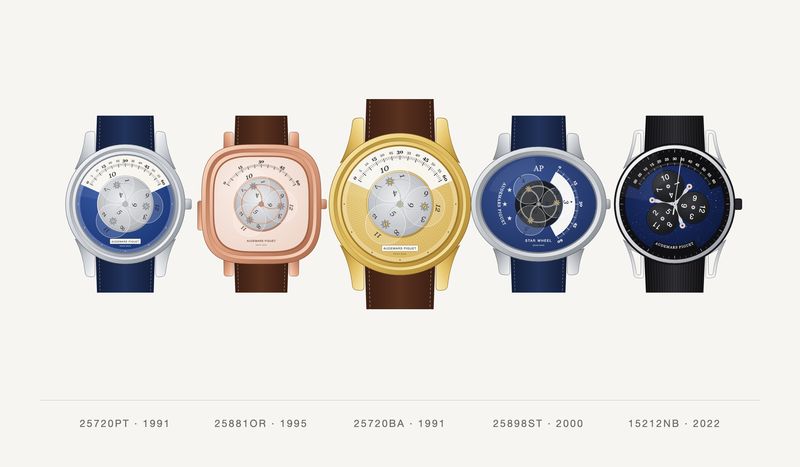
Dial variants of ref. 25720
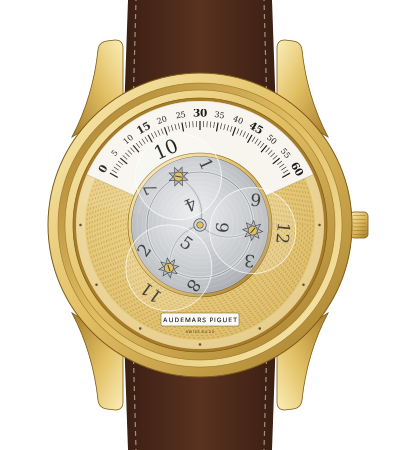
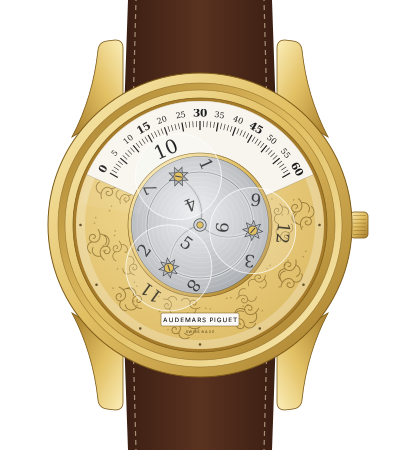
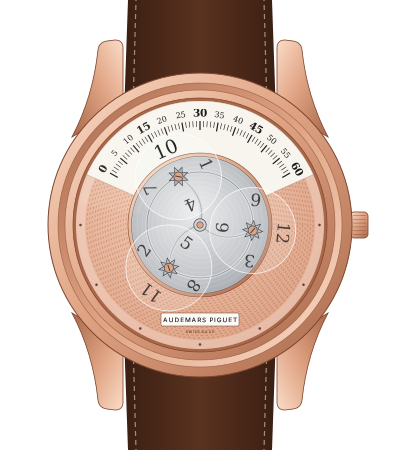
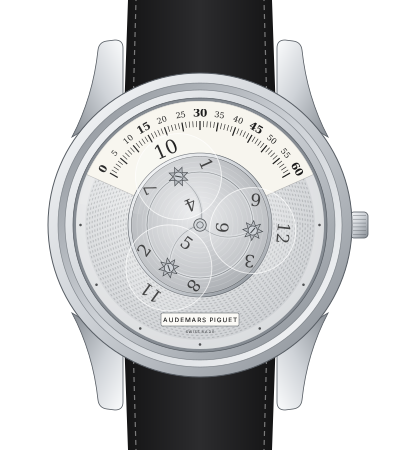
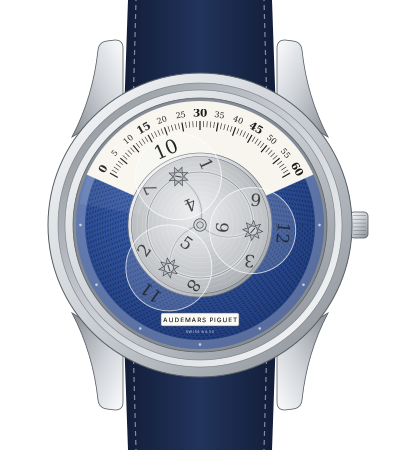
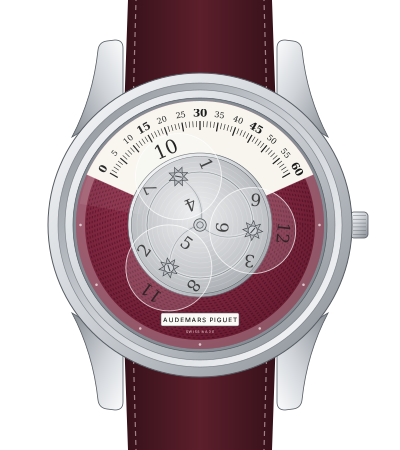
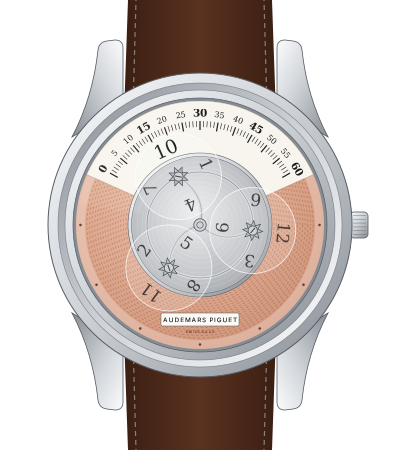
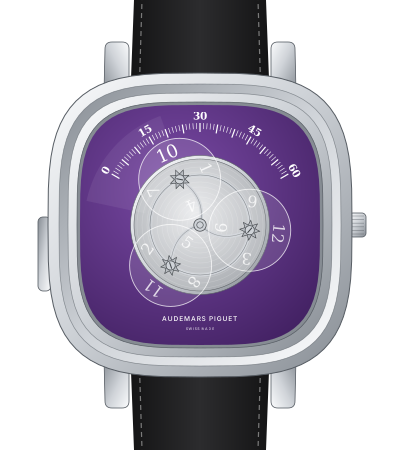
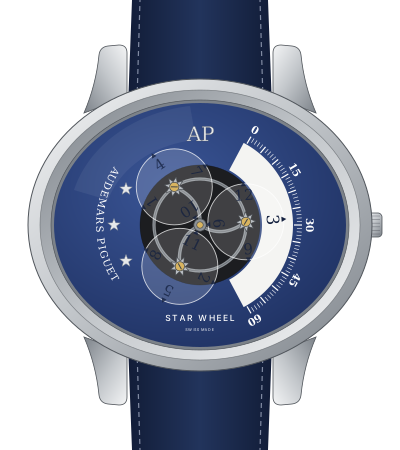
Illustrations by Watchphile; they are schematic, not to scale. Follow the links under each for photographs of real examples.
How many ref. 25720s were made?
Audemars Piguet has never said, and none of the two dozen auction essays we read gives a total — be wary of anyone who quotes one. What can be counted: our researchers logged 59 distinct case numbers in public sales (36 yellow gold, 11 platinum, 12 pink gold), and they fall into a small set of tight blocks — D79xx–D83xx, D112xx–D116xx, D152xx–D153xx, D209xx, D257xx–D258xx, D300xx and D357xx — spanning roughly a thousand numbers in all. AP numbered its cases across the whole production rather than per reference, so that span is a loose ceiling at best, not a count. Taken together with how often the watch surfaces, the evidence points to production in the hundreds rather than the thousands, with yellow gold the clear majority, platinum next and pink gold the scarcest of the three regular metals. That is as far as the record goes; our AP guide sets out the argument in full.
What they sell for
Star Wheels were a CHF 7,000–11,000 watch for most of the 2000s and 2010s. The re-rating began around 2019–2020. Recent public results: yellow gold with guilloché dial CHF 20,000–28,000; pink gold CHF 30,000–45,000; standard platinum CHF 40,000–50,000; platinum with a blue, purple or burgundy dial US$63,000–100,000; the two gem-set unique pieces HKD 1.0–1.375 million (2021). A platinum John Shaeffer repeater made CHF 106,680 at Phillips in November 2024, a steel Millenary about US$45,000 at Christie's in May 2025, and the yellow-gold pocket watch ref. 25743BA a startling HK$990,600 at Phillips Hong Kong in November 2025.
Audemars Piguet Code 11.59 Starwheel (2022–)
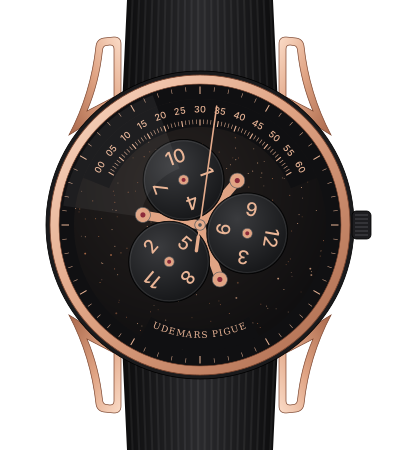
After a nineteen-year gap AP brought the display back on 1 December 2022 inside the Code 11.59 case. It is a different watch in almost every respect: 41 mm, an in-house base calibre, opaque domed aluminium discs instead of clear sapphire, and — for the first time on an AP wandering-hours watch — a centre seconds hand. The minute arc is printed on the black inner bezel from 10 to 2 o'clock. It is regular production rather than a limited edition, but sold only through AP boutiques, and AP has not disclosed volumes.
| Reference | Introduced | Case | Dial and discs | Status | Price |
|---|---|---|---|---|---|
| 15212NB.OO.A002KB.01 | 1 Dec 2022 | 18k white gold, black ceramic case middle and crown, 41 × 10.7 mm | Blue aventurine; black PVD aluminium discs, white numerals | Regular production, boutique only | CHF 48,000 ex-tax / US$57,900 at launch |
| 15212NR.OO.A002KB.01 | Aug–Oct 2025 (quiet catalogue addition) | 18k pink gold, black ceramic case middle | Black aventurine; pink-gold-toned numerals and centre wheel | Regular production | Official launch price not found; US dealers quote US$65,700 retail |
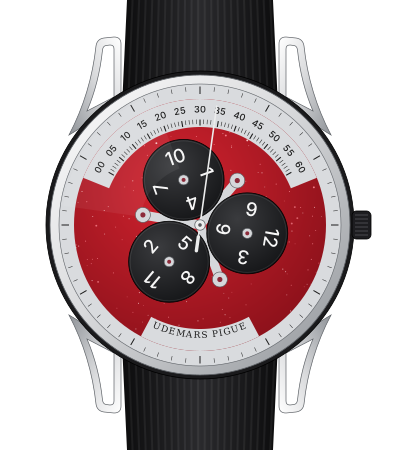
| “SG60” pièce unique | Jul 2025 | White gold and black ceramic | Red lacquer dial, SG60 rotor | 1 piece, for Singapore's 60th year | Sold for SGD 480,000 at a charity dinner, 15 Aug 2025 |
All three use cal. 4310 (cal. 4309 plus the Starwheel module): 261 parts, 32 jewels, 4 Hz, 70-hour reserve. One public auction result so far: HK$537,400 at Bonhams Hong Kong, May 2024. Sources: Audemars Piguet; Monochrome; SJX; SJX on the SG60; Bonhams.
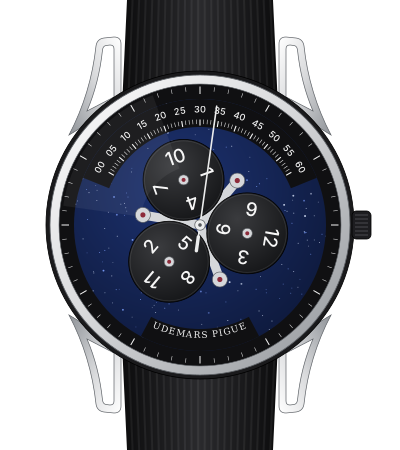
Urwerk: satellite hours since 1997
No company has done more with this display. Felix Baumgartner, his brother Thomas and the artist Martin Frei showed their first watches at the AHCI stand in Basel in April 1997, and the inspiration was not the AP — it was a seventeenth-century Campani night clock that Felix's father, a clock restorer, had on his bench. Urwerk's one mechanical departure matters for collectors: instead of AP's star wheels and jumper springs, which add friction, it indexes its satellites with Geneva (Maltese) crosses, and since 2005 it has been turning those satellites into cubes, torpedoes and prisms and pairing them with retrograde minute hands.
Urwerk makes about 150 watches a year across every model — its 2026 press kit says “around 200” — so even the open-series references below exist in the low hundreds at most. Edition sizes are from Urwerk, its own pre-owned shop (UR-Legends) or piece numbers engraved on auctioned watches; where those disagree we give both.

UR-101 and UR-102 (1997–c. 2003)
The founding pair. Both hide the mechanism completely: a single hour numeral shows in a small window that glides along a semicircular minute track across the top of the case, from 9 o'clock to 3. Martin Frei had Sputnik in mind for the round UR-102; the asymmetric UR-101 picked up the nickname Millennium Falcon. Inside is an ETA 2892-A2 with Urwerk's module and beryllium-bronze Maltese crosses. Production was in the tens, not the hundreds — ten watches sold in 1998, and the planned runs of fifty were never completed.
| Variant | Years | Case | Production |
|---|---|---|---|
| UR-102 “Sputnik”, steel | 1998–c. 2003 | Polished steel, 38 × 12 mm; black or blue minute track | 50 planned, far fewer made; highest number seen is No. 50. Prototype No. 01 made CHF 150,000 at Antiquorum in 2021 |
| UR-102 “Nightwatch” | c. 1999 | Black anodised aluminium, platinum back, luminous numerals | 10 |
| UR-102, grey aluminium | c. 2000 | Matte grey ceramicised aluminium, platinum back | 25 announced; “between 5 and 10” actually made, per Urwerk via Antiquorum |
| UR-101, yellow gold | 1998– | 18k yellow gold, 38 mm; cases hand-made by Thomas Baumgartner | “Very limited”; two sold in 1998 |
| UR-101/40, white gold | 1999 | 18k white gold, 40 mm | 150 or 500 announced, depending on the catalogue; a tiny fraction made |
| UR-101 “Nightwatch” | c. 1999 | Black aluminium, platinum back | Numbered x/50; about 15 made |
Steel UR-102s peaked at CHF 100,800 (Phillips, 2021); No. 11 resold for CHF 60,960 in 2024. The 2001 Goldpfeil × Urwerk watch (ref. GPUR 11300), sometimes listed with these, is a hand-wound chronometer with ordinary hands — not a wandering-hours watch. Sources: Quill & Pad; Monochrome retrospective; A Collected Man; Antiquorum, Phillips and Ineichen lot notes.
UR-103 (2003–10)
The watch that saved the company. On 10 January 2002 Urwerk had CHF 100,000 left and voted to spend it on one more model; the first order was taken at 4 pm on 3 April 2003 at the AHCI stand. Four satellites of three numerals each (1-5-9, 2-6-10, 3-7-11, 4-8-12) hang beneath an orbital cross that turns once every four hours; as each satellite passes the crown a Geneva cross flips it 120° to bring up its next numeral, and the active one sweeps a minute arc along the bottom edge of the case. On the back is a world first, the “control board”: power reserve, a 15-minute dial and seconds for precise setting, and a fine-adjustment screw the owner can turn. Cal. 3.03, hand-wound, 21,600 vph, about 43 h; case 50 × 36 × 13.5 mm with the crown at 12.
| Reference | Year | Case | What changed | Edition |
|---|---|---|---|---|
| UR-103.01 | 2003 | White gold or red gold | Closed, finely grooved front; only a slot for the hour and minutes | 25 + 25 |
| UR-103 Junkers | 2004 | Platinum, engraved like riveted aircraft skin | Édition Spéciale | Unique |
| UR-103.03 “Targa” | 2005 | White or red gold | First open sapphire: all four satellites visible | Open series; No. 120 seen |
| UR-103 Blackbird | 2006 | Black-coated platinum, smooth | All-black display | 10 (single source) |
| UR-103.05 | 2006 | Polished platinum | Extra sapphire windows in the case flanks | 50 |
| UR-103.06 Joaillerie | 2006 | Diamond-paved, 277 stones | — | 10, or 25 gold plus 10 platinum — sources differ |
| UR-103.08 TiAlN | 2007 | TiAlN-coated steel, aubergine sheen | Curved or rarer angular crystal | c. 50 per Phillips (20 angular); Monochrome reads serials as 100+ |
| UR-103.09 | 2007–08 | White or red gold | Revised grooves | Open series; No. 130 seen |
| UR-103.09 AlTiN | c. 2009–10 | Black AlTiN steel | Among the last | 5 |
| UR-103 Hexagon | Sep 2008 | Black-coated platinum | Angular crystal and satellites | 10 |
| UR-103T Tarantula | 2009 | AlTiN steel, red gold or white gold | Fully open front; spider-like ARCAP carrier | 60 / 60 / 33 |
| UR-103T Mexican Fireleg | Mar 2010 | AlTiN steel or gold | Orange lume; cal. 3.04 | 60 |
| UR-103T Shining T | 2010 | AlTiN-coated gold | Transparent sapphire satellites; the last regular 103 | 33 |
| UR-103 Phoenix | 2011 | Engraved white gold | Made for Only Watch after production ended | Unique — EUR 55,000 |
Documented limited editions add up to roughly 380–405 watches; with the open-series .03, .08 and .09 the family plausibly reaches the high hundreds, though Urwerk has never published a total. Three further engraved unique pieces exist (Art Deco, Dragon, Eagle). The market in 2024–26 is about CHF 24,000–55,000, with premiums for the first-series .01 and the angular-crystal .08. Sources: Urwerk; UR-Legends; Monochrome; Phillips and Antiquorum lot notes.
Harry Winston Opus V (2005)
The fifth Opus — and the last chosen by Maximilian Büsser before he left to found MB&F — was built by Felix Baumgartner, and it is where Urwerk's satellites first became three-dimensional. Three four-sided blocks of four numerals each orbit and turn on two axes; the current hour sits at the foot of a large retrograde minute pointer that sweeps a 120° scale and flies back at sixty. A five-year service indicator on the back was another first. Cal. HW1026, hand-wound, 21,600 vph, five-day (122 h) reserve; the case is about 50 mm across.
| Version | Edition |
|---|---|
| 18k rose gold | 45 |
| Platinum | 45 |
| Platinum, round-cut diamonds | 7 |
| Platinum, baguette diamonds | 3 |
| Total | 100 |
Worth US$160,000–225,000 at auction in 2006–08 and roughly CHF 60,000–150,000 in 2019–23, platinum ahead of gold. The launch price and official reference numbers could not be found. Sources: Quill & Pad; Phillips, Ineichen and Antiquorum lot notes.
UR-201, UR-202 and UR-203 (2007–c. 2012)
The Opus V idea under Urwerk's own name, with a unique twist: a telescopic minute hand runs through the middle of each of the three cube satellites and lengthens or shortens as it goes, so that its tip follows a minute track laid out as three straight segments rather than an arc. The hammer-shaped crystal gave the series its Hammerhead nickname. Case 45.7 × 43.5 × 15 mm.
| Model | Launch | Calibre | Notable | Editions |
|---|---|---|---|---|
| UR-201 | 2007 | UR 7.01, hand-wound (Jaquet / La Joux-Perret base), 50 h | Control board with “oil change” indicator and a 100-year odometer; from US$122,000 | Gold series un-numbered; platinum “Black Shark” 10 |
| UR-202 | Apr 2008 | UR 7.02, automatic (Girard-Perregaux base, later Zenith Elite) | First watch to regulate its winding with air: twin turbines, Free / Sport / Stop; moon phase | Black platinum 10 or 20 (sources differ); White Shark (2010) 12 |
| UR-202S Full Metal Jacket | Mar 2011 | UR 7.03 per Urwerk | Striped dial; Urwerk's first bracelet | 50, plus one unique in platinum |
| UR-203 | Jan 2010 | UR 7.03, automatic | Black platinum; skeletonised module 65% lighter; 150-year odometer | 20 |
The 200 series is the least expensive way into Urwerk's cube satellites: platinum limited editions trade at CHF 35,000–60,000 against US$122,000–230,000 new. The UR-201's orphaned hand-wound base calibre makes service history essential. The pocket-sized UR-1001 Zeit Device (2011; 8 in AlTiN at CHF 340,000, the 2015 Titan at CHF 380,000, and the engraved Amadeus of August 2026) carries two satellite carousels — one for the time, one for an annual calendar — but it is a pocket watch. Sources: SJX; The Hour Glass; Urwerk press kits; Sotheby's, Ineichen and Antiquorum lot notes.

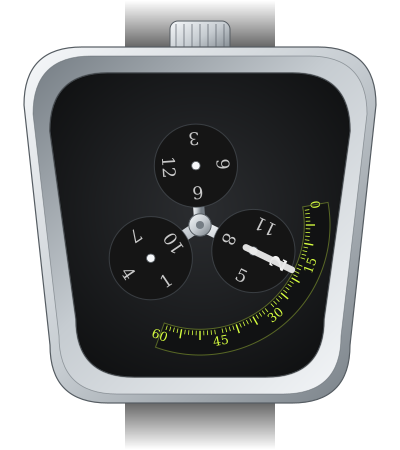


UR-110 “Torpedo” (2011–15)
The watch that put Urwerk on a Marvel film set. Three arrow-shaped “torpedo” satellites, four numerals each, ride on planetary gears so that they counter-rotate against the carousel and always stay parallel, pointing at a minute track that runs down the right-hand side of the case — readable without pulling back a cuff. A control board on the dial adds day/night, small seconds and an “oil change” service indicator. It won the Best Design prize at the 2011 Grand Prix d'Horlogerie de Genève. Cal. UR 9.01, 46 jewels, 39 h, twin-turbine winding; 47 × 51 × 16 mm. Every variant shares the titanium case and movement — the front plate is the whole story.
| Variant | Year | Front plate | Edition | Launch price |
|---|---|---|---|---|
| UR-110 (TI) | 2011 | Brushed steel on titanium | 55 | c. CHF 80,000 |
| UR-110 AlTiN | 2011–12 | Black AlTiN-coated steel | 55 | Not found |
| UR-110 ZrN “Champagne Supernova” | Oct 2011 | Pale-gold zirconium-nitride steel; piece number shown by which numeral is red | 12 | CHF 105,000 |
| UR-110 AlTiN, The Hour Glass | Feb 2012 | AlTiN, blue numerals | 5 | S$199,000 |
| UR-110 RG | Feb 2012 | 5N red gold — Robert Downey Jr.'s watch in Spider-Man: Homecoming | 55 | US$115,000 |
| UR-110 ST | Mar 2012 | Grooved steel, black AlTiN, yellow numerals | 55 | Not found |
| UR-110 TTH “Tantalum Hull” | Mar 2012 | 4.1 mm tantalum | 55 | Not found |
| UR-110 PT | 2013 | 950 platinum | 20 | S$190,000 |
| UR-110 PTH | Apr 2013 | Blackened platinum, red on black | 20 | Not found |
| UR-110 Eastwood | Feb 2015 | Macassar ebony or red ivory wood, tweed straps by Timothy Everest | 5 + 5 | CHF 105,000 |
| UR-110 Bakelite | Oct 2021 | Brown Bakelite on a refurbished watch; tenth-anniversary farewell | Unique | Sold for CHF 120,000, for the Swiss Red Cross |
If every series was completed the UR-110 totals about 342 watches. Edition sizes of 55 are confirmed by piece numbers on Phillips, Sotheby's and Ineichen lots (16/55, 47/55, 53/55, 55/55). Recent results: titanium 16/55 CHF 63,500 (Phillips, Nov 2025); a platinum piece HK$756,000 in Nov 2022 and US$50,800 a year later. Sources: Urwerk; SJX; Quill & Pad; Phillips.
UR-210 “Maltese Falcon” (2012–20)
Successor to the UR-202 and the first of the big retrograde Urwerks. Three hour cubes sit on the carousel; an oversized three-dimensional minute hand — milled aluminium, 0.302 grams — encloses the current hour and carries it across a 120° scale, then snaps back in under a tenth of a second to collect the next. At 11 o'clock sits a world first: a winding-efficiency indicator comparing energy generated with energy used over the previous two hours. A selector on the back sets the rotor to FULL, REDUCED or STOP. Cal. UR-7.10, 51 jewels, 39 h; 43.8 × 53.6 × 17.8 mm; CHF 137,000 at launch.
| Variant | Year | Case | Edition | Launch price |
|---|---|---|---|---|
| UR-210 | Sep 2012 | Titanium and steel | 35 per aBlogtoWatch; presented elsewhere as a standard model | CHF 137,000 |
| UR-210 AlTiN | 2012–13 | Black AlTiN steel on titanium | 35 per dealers — unverified | Not found |
| UR-210 RG | 2013 | 5N red gold, black titanium back | 75 | S$229,000 |
| UR-210Y “Black Hawk” | Feb 2014 | AlTiN steel, yellow-green lume | 75 | US$175,000 |
| UR-210S “Full Metal Jacket” | Jan 2015 | Steel, on Urwerk's first metal bracelet | 35 | CHF 145,000 |
| UR-210 CP “Clou de Paris” | 2016 | Hobnail-engraved AlTiN bezel, yellow accents | 75 (Monochrome: not limited; one retailer: 22) | CHF 138,000 |
| UR-210 Amadeus | Jun 2017 | UR-210S fully hand-engraved by Florian Güllert | 3–5, each unique | CHF 210,000 |
| UR-210 Dubai Edition | late 2017 | Engraved steel, for Seddiqi & Sons | Unique | AED 840,000 |
| UR-210 Black Platinum (BPT, “Royal Hawk”) | Jan 2018 | Black DLC platinum | 25 | CHF 155,000 |
| UR-210 Final Edition | Jun 2020 | Black DLC steel and titanium | 7 | CHF 137,000 |
Our arithmetic puts the run at roughly 315–370 watches over eight years. Results: RG 58/75 €130,000 (Antiquorum, Jul 2022); black-coated 09/75 CHF 120,650 (Phillips, Nov 2023); UR-210S 01/35 CHF 82,550. Sources: Urwerk; SJX; Monochrome; Antiquorum.
UR-105 (2014–21)
Urwerk's volume model for seven years and the truest heir to the UR-103: four satellites of three numerals each on an aluminium carousel, indexed by beryllium-bronze Geneva crosses, parading along an arched minute rail at the bottom of the dial. There are three generations — the hand-wound UR-105M “Knight” (cal. UR 5.01), the automatic UR-105 TA with twin turbines (UR 5.02, Zenith Elite base per SJX) and the UR-105 CT “Streamliner” with a hinged, fluted lid and digital seconds (UR 5.03). Case 39.5 × 53 mm.
| Variant | Year | Case | Edition | Launch price |
|---|---|---|---|---|
| UR-105M Iron Knight | Apr 2014 | Titanium, steel bezel | 77 | CHF 58,000 |
| UR-105M Dark Knight | Apr 2014 | Titanium, AlTiN steel bezel | 77 | CHF 63,000 |
| UR-105 TA Black Orange | Apr 2015 | Titanium, black PVD bezel, orange track | 100 | CHF 58,000 |
| UR-105 TA Black Lemon | Apr 2015 | As above, yellow track | Not found | CHF 58,000 |
| UR-105 TA All Black | Apr 2015 | Black PVD throughout | 100 | CHF 64,000 |
| UR-105 TA RG | Apr 2015 | Red-gold bezel on black titanium | 100 | CHF 66,000 |
| UR-105 T-Rex | Jan 2016 | Patinated bronze with graduated scale pattern | 22 | CHF 65,000 |
| UR-105 TA Clockwork Orange | Mar 2016 | Titanium, orange accents | Not found | c. CHF 60,000 |
| UR-105 Raging Gold | Oct 2016 | Engine-turned red-gold bezel | 22 | CHF 66,000–67,000 |
| UR-105 CT Streamliner Iron | Sep 2017 | Titanium and polished steel | 50 | CHF 65,000 |
| UR-105 CT Streamliner Black | Sep 2017 | Titanium and black PVD steel | 50 | CHF 65,000 |
| UR-105 CT Kryptonite | Jun 2018 | Black AlTiN, green lume | Not found | CHF 65,000 |
| UR-105 CT Maverick | Jan 2019 | Bronze lid on titanium | 22 | CHF 67,000 |
| UR-105 The Hour Glass | Jul 2019 | Bronze cover, black titanium | 3 | S$100,100 |
| UR-105 TTH “Tantalum Hull” | May 2021 | Tantalum lid; the last UR-105 | 12 | CHF 77,000 |
Verified series add up to 635 watches; with the three un-numbered colourways and half a dozen unique pieces (three bronze watches engraved by Johnny “King Nerd” Dowell for Revolution, two Robert Downey Jr. watches, the 2023 “Trinity”), a plausible total is 750–900 — the largest Urwerk family of its era. Ordinary TA and CT pieces trade around CHF 33,000–57,000; Downey's Endgame CT made US$312,500 and T-Rex no. 1/22 HK$567,000. Sources: Urwerk; Monochrome; SJX; Phillips.
UR-106 Lotus (2015) and UR-T8 (2017)
The UR-106 Lotus was Urwerk's first women's watch: three satellites of four numerals arranged like petals over a serrated minute scale, with a lapis-lazuli moon phase at the centre. Cal. UR 6.01 on a Zenith Elite base; 35 × 49.4 × 14.45 mm. The diamond-set Lotus and the Black Lotus were 11 pieces each at CHF 85,000; a unique piece without diamonds made CHF 90,000 at Only Watch 2015. Two later versions, Flower Power and Black Pink, are listed in Urwerk's archive without published edition sizes.
The UR-T8, for the brand's twentieth anniversary, is the only reversible wandering-hours watch: squeeze two buttons, lift the inner case, turn it over and it presents a textured titanium shield. Inside is Urwerk's largest carousel — three arms, four numerals per satellite, each satellite on planetary gearing so its numeral stays level across the 120° arc. Cal. UR 8.01; 60.2 × 48.4 × 20 mm; CHF 100,000. The initial series was 60 (30 bicolour, 30 black); the bronze-shielded Skull (2019) was 5, and the Colibri and Raptor were unique. We found no public auction record for any UR-T8.


UR-100 SpaceTime and UR-100V (2019–)
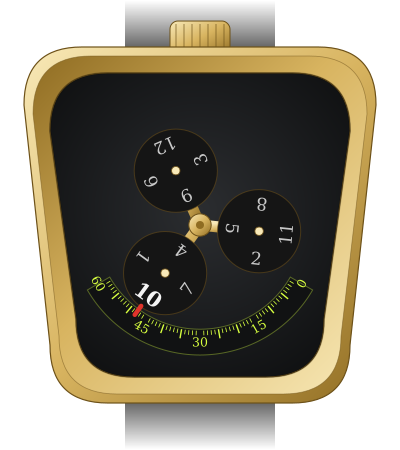
Launched on 12 September 2019 as the entry point to the brand at CHF 48,000, the UR-100 returns to the simplest Urwerk layout: three satellites of four numerals each, sweeping a 120° minute track along the lower edge of the dial. Its party trick comes after the hour. Instead of vanishing at 60, the pointer of the departing satellite travels on under the dial and reappears in two side windows that count kilometres rather than minutes — the distance a point on the equator covers through the Earth's rotation in twenty minutes (555 km), and the distance the Earth travels around the Sun in the same time (35,740 km). The idea came from a nineteenth-century regulator by Gustave Sandoz that Felix Baumgartner's father gave him.
There are two generations. The UR-100 (2019–21) uses cal. UR 12.01 on a Zenith Elite base. The UR-100V (November 2020 onward) uses cal. UR 12.02 on a Vaucher base — SJX reports that the V stands for Vaucher — and the two overlapped during 2021. The standard case is 41 × 49.7 × 14 mm; the LightSpeed models are larger at 43 × 51.7 × 14.6 mm.
| Variant | Launch | Case | Edition | Launch price |
|---|---|---|---|---|
| UR-100 SpaceTime Iron | Sep 2019 | Titanium and steel | 25 | CHF 48,000 |
| UR-100 SpaceTime Black | Sep 2019 | Black-coated titanium and steel | 25 | CHF 48,000 |
| UR-100 GunMetal | Jan 2020 | Gunmetal PVD, neon-green indications | 25 | CHF 48,000 |
| UR-100 Gold “C-3PO” | May 2020 | 18k 2N yellow gold | 25 (no. 1 engraved “FIGHT C19” and sold for charity at CHF 96,500) | CHF 58,000 |
| UR-100 Fireleg | c. 2020–21 | Black PVD, orange numerals | 25 | Not found |
| UR-100V Iron | Nov 2020 | Titanium and steel, first Vaucher-based model | 25 | CHF 48,000 |
| UR-100V T-Rex | Jan 2021 | Patinated, scale-textured bronze | 22 | CHF 50,000 |
| UR-100V Blue Planet | Mar 2021 | Blue PVD steel | 25 | CHF 48,000 |
| UR-100V P.02 (Collective Horology) | Jul 2021 | Gunmetal; space-shuttle launch and landing scales | 20 | US$62,500 |
| UR-100 Electrum | Sep 2021 | Gold–palladium alloy, grooved case; last Zenith-based edition | 25 | CHF 62,000 |
| UR-100V Full Titanium Jacket | Nov 2021 | Titanium on matching bracelet | 25 per Monochrome; SJX says unlimited | CHF 55,000 |
| UR-100V C52 | Feb 2022 | 52-layer CTP carbon | 25 | CHF 53,000 |
| UR-100V Time and Culture I (with SJX) | Mar 2022 | Copper-toned steel, engraved Aztec sun stone | 20 | CHF 68,000 |
| UR-100V Full Black Titanium Jacket | Jun 2022 | Black DLC titanium on bracelet | 25 | CHF 65,000 |
| UR-100V UltraViolet | Aug 2022 | Violet DLC titanium | Un-numbered at launch; “25” in retailer guides | CHF 55,000 |
| UR-100V Magic T | Apr 2023 | Microblasted titanium on bracelet | 50 per SJX; un-numbered per Monochrome | CHF 58,000 |
| UR-100V Stardust | Aug 2023 | Steel, 400 snow-set diamonds | About 10 a year | CHF 88,000 |
| UR-100V Time and Culture II “Sumer” | Oct 2023 | Coated steel, engraved sapphire dome | 30 | CHF 72,000 |
| UR-100V LightSpeed | Feb 2024 | 54-layer carbon, 43 mm; light-travel-time scale for the eight planets | 50 per SJX and Revolution | CHF 65,000 |
| UR-100V Magic T Hunter Green | Jan 2025 | Sandblasted titanium, green carousel | 35 (one retailer says 25) | CHF 58,000 |
| UR-100V Time and Culture III | Jun 2025 | Yellow gold, cloisonné enamel | Unique — single source, unconfirmed | On request |
| UR-100V LightSpeed Ceramic | Feb 2026 | White ceramic composite, 43 mm | 50 | CHF 67,000 |
If every numbered run was completed, the Zenith-based UR-100 totals 150 watches and the numbered UR-100V editions about 280, plus the open runs. Standard pieces have traded at roughly US$31,000–48,000 at auction in 2024–26, under retail; the outlier is a LightSpeed at US$60,960 (Phillips New York, December 2025). Sources: Urwerk; SJX 2019; SJX on the T-Rex; Monochrome 2019; Monochrome 2026; Phillips.


UR-220 “Falcon Project” (2020–22)
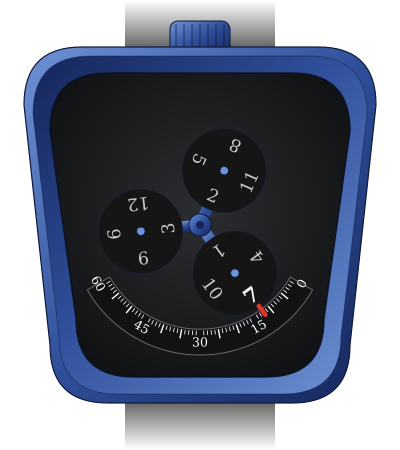
The hand-wound successor to the UR-210: the same cube satellites and three-dimensional retrograde minute hand over a 120° scale, in a case thinned from 17.8 to 14.8 mm. The winding-efficiency gauge gives way to a 48-hour power reserve split across two 24-hour indicators, and the case back carries an “oil change” counter that tallies the months the movement has actually run and asks for a service at 39. Cal. UR-7.20, 59 jewels; case 43.8 × 53.6 × 14.8 mm.
| Variant | Launch | Case | Production | Launch price |
|---|---|---|---|---|
| UR-220 C81 “Falcon Project” | Sep 2020 | 81-layer CTP carbon | Un-numbered | CHF 145,000 |
| UR-220 All Black | Oct 2020 | Black DLC titanium and steel | “25 watches” per one press-based source | CHF 130,000 |
| UR-220 SL Asimov | Jun 2021 | Carbon; hour cubes cast entirely in Super-LumiNova | Not published | CHF 147,000 |
| UR-220 RG “Miami Vibe” | May 2022 | 4N red gold, white rubber strap; the last UR-220 | 14 made per Phillips | CHF 149,000 |
Urwerk's site gives total output as 15 pieces a year, which puts the whole UR-220 run at only a few dozen watches. The one public result: HK$1,143,000 for a red-gold piece at Phillips Hong Kong, May 2025. Sources: Urwerk; Monochrome; SJX; Phillips.
UR-120 “Spock” (2022–26)
The UR-110's grandchild, with its minute track again on the right-hand side of the case. Each of the three satellites is built from two elongated four-faced studs. After a satellite leaves the minute track it splits open into a V — the Vulcan salute that gives the watch its nickname — each half turns one face, and a lyre-shaped spring snaps them shut showing the next hour it will need. Cal. UR-20.01 on a Zenith Elite base; 47 × 44 × 15.8 mm.
| Variant | Launch | Case | Edition | Launch price |
|---|---|---|---|---|
| UR-120 “Spock” | Oct 2022 | Sandblasted titanium and steel | Un-numbered | CHF 100,000 |
| UR-120 Space Black | Jun 2023 | Black DLC, neon-yellow track | Un-numbered | CHF 110,000 |
| UR-120 Blue Planet | Jun 2026 | Blue PVD steel, gold-plated details; announced as the last UR-120 | 20 | CHF 115,000 |
UR-230 (2023–25)
Third generation of the UR-210 line and a return to automatic winding, with an adjustable air brake on the rotor set from the case back. Three rotating hour blocks cross a 120° sector inside a skeletonised retrograde hand. Cal. UR-7.30 on a Vaucher base; 44.8 × 53.6 mm.
| Variant | Launch | Case | Edition | Launch price |
|---|---|---|---|---|
| UR-230 Eagle | Nov 2023 | Black DLC titanium and CTP carbon, hinged cover | 35 | CHF 180,000 |
| UR-230 Polaris | Dec 2024 | White ceramic composite | 35 | CHF 150,000 |
| UR-230 Black Star | Dec 2025 | Black ceramic composite; presented as the final UR-230 | 35 | CHF 150,000 |
UR-150 Scorpion (2024–)
The most significant change to the satellite display in years. The retrograde hand now sweeps 240°, twice Urwerk's usual arc, and at the top of the hour it flies back while all three satellites rotate 270° at once — in about a hundredth of a second. To do it Urwerk replaced its customary Maltese crosses with a snail cam, a toothed rack and a planetary gear train, damped by a governor. Cal. UR-50.01 on a Vaucher base, 43-hour reserve; 42.5 × 52.3 × 14.8 mm.
| Variant | Launch | Case | Edition | Launch price |
|---|---|---|---|---|
| UR-150 Scorpion Titan | Oct 2024 | Blasted titanium and steel, green accents | 50 | CHF 88,000 |
| UR-150 Scorpion Dark | Oct 2024 | Anthracite PVD, red accents | 50 | CHF 89,000 |
| UR-150 Blue Scorpion | Sep 2025 | Steel and titanium; blue satellites and hand | 50 | CHF 90,000 |
| UR-150 Golden Scorpion | Sep 2026 | 2N yellow gold | 25 | CHF 105,000 |
UR-102 Reloaded and the UR-101 revival (2023–)
Urwerk's first heritage pieces revisit the two watches it showed in 1997. The UR-102 Reloaded (March 2023) grows the original from 38 to 41 mm; a single hour numeral travels in a window along a semicircular minute track from 9 to 3 o'clock. It was sold as 25 boxed pairs — one raw titanium, one black — at CHF 56,000 the set. The UR-101 T-Rex (March 2025, 100 pieces, CHF 38,000) uses two satellites of six numerals each against a 180° arc in a patinated bronze case and is the least expensive new Urwerk; the diamond-set UR-101 Diamond Sky followed in April 2026 (25 pieces, CHF 85,000). Split-up Reloaded singles have made roughly US$22,000–38,000 at auction.
Collaborations
| Watch | Year | What it is | Edition | Price / result |
|---|---|---|---|---|
| Laurent Ferrier × Urwerk Arpal One | 2017 | Ferrier's streamlined case around the UR-105's four-satellite calibre (UR 5.03), for Only Watch | Unique | CHF 100,000 |
| Laurent Ferrier × Urwerk LR-UR 2 | 2018 | The same watch in matte anthracite titanium | 4 | CHF 88,000 |
| De Bethune × Urwerk Moon Satellite | 2019 | Urwerk wandering-hours module on a De Bethune hand-wound calibre with spherical moon phase, for Only Watch | Unique | CHF 300,000 in 2019; CHF 480,000 when resold at Marteau & Co in June 2026 |
| Ulysse Nardin × Urwerk UR-FREAK | Nov 2025 | The Freak's flying carousel re-geared to turn once every three hours and carry three Urwerk hour satellites around the oscillator; ref. 2413-500LE-2A-UR/3B, 44 mm titanium, cal. UN-241, 90 h | 100 | CHF 100,000 |
Sources: SJX on the UR-FREAK; Monochrome; SJX on the Moon Satellite; Marteau & Co; Monochrome on the LR-UR 2.
Urwerks that are not satellite-hour watches, so that they are not mistaken for one: the UR-CC1 (linear), UR-111C (cones and a linear retrograde), UR-112 Aggregat (jumping prisms), EMC and AMC (hands), and the 2025 UR-10 SpaceMeter (central hands). The UR-1001 Zeit Device does use satellites, but it is a pocket watch.
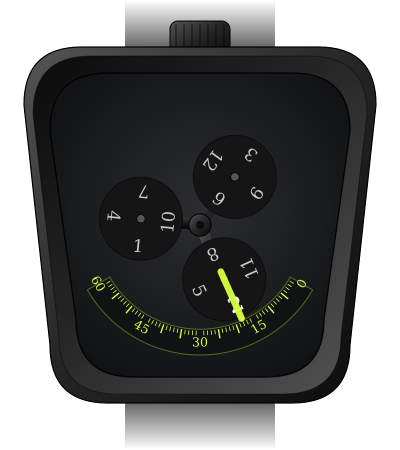
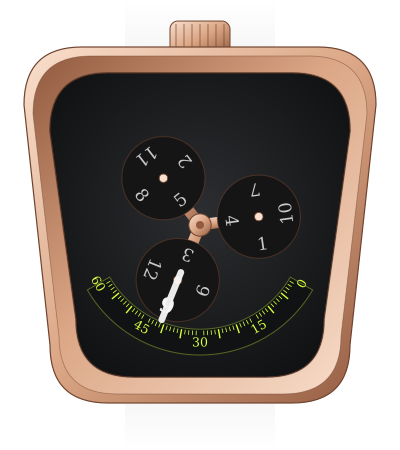
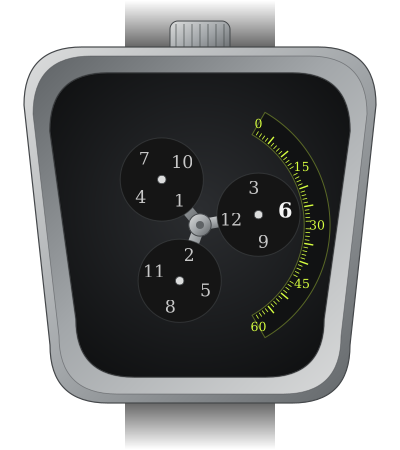
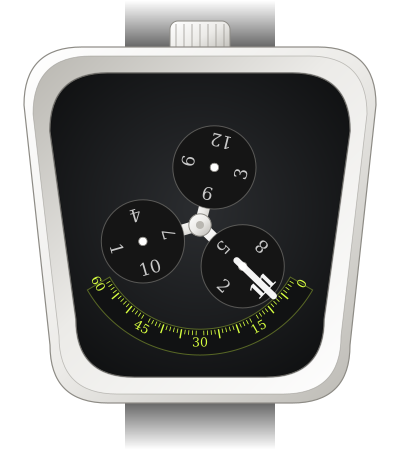
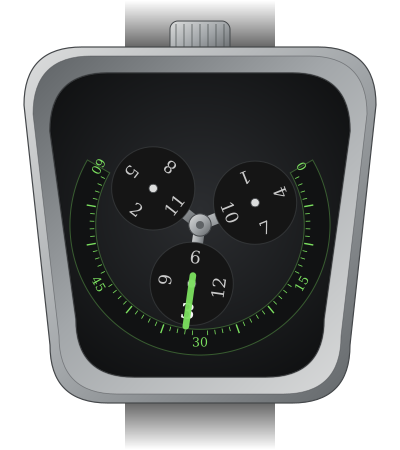
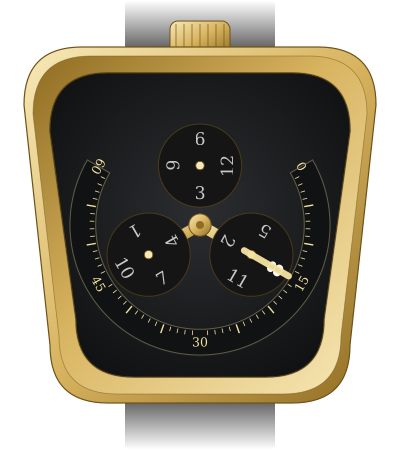
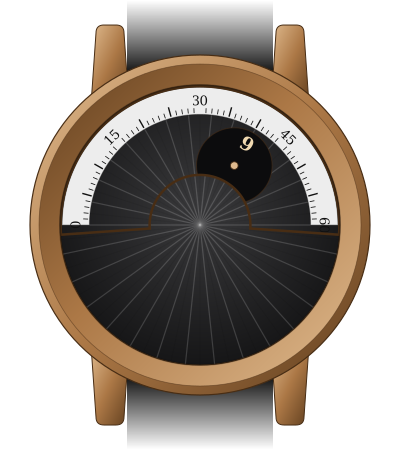
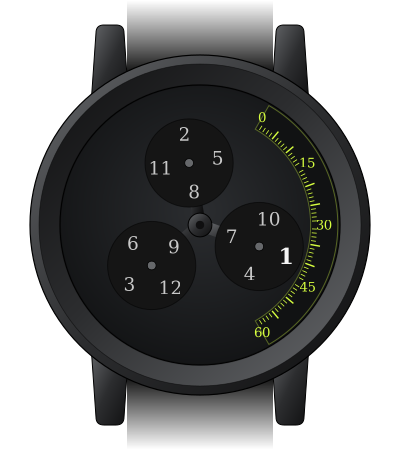
Illustrations by Watchphile are schematic and not to scale; they show the layout of each display, not every detail of the watch. Follow the links for photographs.
Vacheron Constantin: wandering hours as a canvas
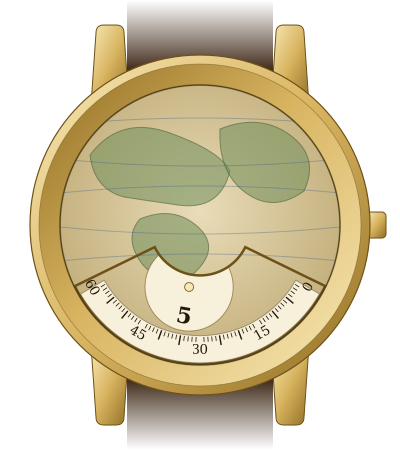
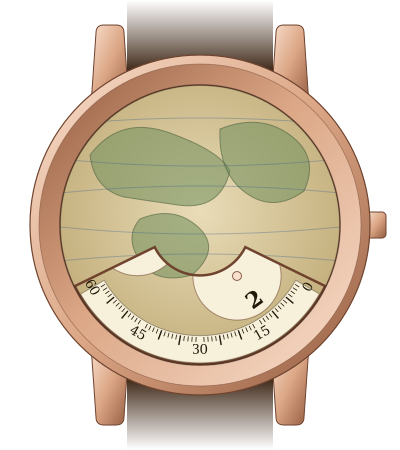
After AP and Urwerk, Vacheron Constantin has made more of these watches than anyone — and for the opposite reason. VC uses the display because it gets the hands out of the way of the artwork. A three-armed wheel carries a four-numeral satellite on each arm, stepped by a cam shaped like the brand's Maltese cross; only one numeral is ever visible, drifting down a fixed 120° minute scale at the edge of an enamel or engraved dial. The first two series use cal. 1126 AT (Jaeger-LeCoultre 889 family, like the AP); everything since 2015 uses cal. 1120 AT, built on VC's ultra-thin 1120 with the Hallmark of Geneva.
| Model | References | Year | Case | Dial | Edition |
|---|---|---|---|---|---|
| Métiers d'Art Tribute to Great Explorers — Magellan, Zheng He | 47070/000J-9076, -9084 | 2004 | Yellow gold, 40 mm | Two-level grand feu enamel maps by Jean and Lucie Genbrugge | 60 each |
| Tribute to Great Explorers — Christopher Columbus, Marco Polo | 47070/000J-9085, -9086 | 2008 | Yellow gold, 40 mm | As above | 60 each |
| Métiers d'Art “Sputnik” | 47071/000G-9314 | 2007 | White gold, 40 mm | Blue dial with engraved white-gold Sputnik; cal. 1126 AJ. Sold only through VC's Moscow boutique | 10 |
| Métiers d'Art Savoirs Enluminés — Vultures, Caper, Altion | 7000S/000G-B001 to -B003 | 2015 | White gold cushion, 40 × 49.5 mm | Enamel scenes from the twelfth-century Aberdeen Bestiary; €100,000 | 20 each |
| Les Cabinotiers The Singing Birds — Hummingbird, Blue Tit, Blue Jay, Robin | 2010C/000R-B681 to -B683, 000G-B684 | 2020 | Pink gold (Robin in white gold), 40 mm | Champlevé enamel birds; minute sector on the right | 4 unique pieces |
| Tribute to Great Explorers — Bartolomeu Dias, Vasco da Gama, Pedro Álvares Cabral | 7500U/000R-B687 to -B689 | 2021 | Pink gold, 41 × 11.7 mm | Enamel after the 1519 Miller Atlas; CHF 133,000 | 10 each |
| Tribute to Explorer Naturalists — Cap-Vert, Détroit de Magellan, Terre de Feu, Cap de Bonne-Espérance | 7500U/000G-B991, 000R-B992, 000G-B993, 000R-B994 | 2023 | White or pink gold, 41 mm | Enamel, engraving and sculpted gold on the voyages of HMS Beagle; €203,000 | 10 each |
| Les Cabinotiers The Labours of Heracles — Hydra, Nemean Lion, Stymphalian Birds, Cretan Bull | 2010C/000G-305C to -308C | Nov 2025 | White gold, 40 mm | Engraved map, miniature painting and micro-sculpture; arc on the right | 4 unique pieces |
Announced maximum across all eight groups: 388 watches in twenty-one years. The yellow-gold first series has softened at auction, from CHF 102,500 in 2013 to CHF 50,000–60,000 in 2023–24. The Sputnik's display is catalogued by Antiquorum only as “rotating disk,” so treat its inclusion as probable rather than proven. Sources: SJX; Vacheron Constantin press releases 2020–25; Monochrome; Antiquorum, Phillips and Sotheby's lot notes.
Parmigiani, H. Moser, Hautlence and the Golden Wheel
| Watch | Reference | Year | Case | Movement and display | Edition | Launch price |
|---|---|---|---|---|---|---|
| Parmigiani Fleurier Toric minute repeater with sector display — the first “Toric Capitole” | PFH478-1200100 | Nov 2011 | White gold, 45 × 12.9 mm, engraved and enamelled bezel | Cal. PF321, hand-wound minute repeater on cathedral gongs; three four-armed satellites on Maltese crosses; closed mother-of-pearl dial with sector at the top | Numbered; “5” per one catalogue | On request |
| Parmigiani Toric Capitole, rose gold | PFH476-1001300-HA1241 | SIHH 2019 | Rose gold, 45 × 12.1 mm | As above with the satellites exposed; dial engraved in the spiral of Michelangelo's Capitoline paving | Unique (a yellow-gold sibling is also reported) | CHF 390,000 |
| Arnold & Son Golden Wheel | 1HVAR.M01A.C120A | 2015 (dial revised 2016) | Red gold, 44 mm | Cal. A&S6018 automatic; three sapphire discs on a red-gold carousel over a mother-of-pearl sector, with dead-beat centre seconds — the first time the two were combined | 125 | CHF 43,300 |
| H. Moser & Cie Endeavour Flying Hours “Funky Blue” | 1806-0200 | Jan 2018 | White gold, 42 × 12.3 mm | Cal. C806 (Moser HMC 200 with Hautlence module), 72 h. Inverted layout: three fixed hour discs, and a sapphire disc with a 240° minute sector that wanders past them | 60 | CHF 32,000 |
| Endeavour Flying Hours “Cosmic Green” | 1806-0201 | 2019 | White gold | As above | 100 | CHF 35,000 |
| Endeavour Flying Hours, luminous blue | 1806-0202 | 2019 | White gold | Hour discs in Globolight | 100 | CHF 35,000 |
| H. Moser Pioneer Flying Hours | 3240-1200 (steel); 3240-0900 (red gold and titanium, aventurine) | Sep 2025 | 42.8 mm, 120 m | New cal. HMC 240; the hours now jump instantly behind shutters | Steel open; gold 100 | CHF 29,000 / 39,000 |
| Hautlence HL Vagabonde 01, 02, 03 | H2205-0500, -0501 | 2018–19 | Titanium TV-screen case, 39 × 46 mm | Cal. HTL 205-1; same inverted layout as the Moser | 28 each (03 not found) | CHF 26,900 |
| Hautlence HL Vagabonde, Cortina edition | — | Dec 2018 | Red gold | — | 5 | CHF 34,900 |
| Hautlence HL Vagabonde Tourbillon | H2405-0400 | Jan 2019 | Red gold | Cal. HTL 405-1, flying tourbillon | 10 per dial, two dials | CHF 79,000 |
| Hautlence Vagabonde Series 4 and × Black Badger | AB30-ST00, AB30-ST01 | 2022, 2023 | Steel, 43 × 50.8 mm, 100 m | Cal. B30; hours hidden under fixed discs and jumping | 28 each | CHF 30,000 / 33,000 |
| Hautlence Vagabonde Tourbillon Series 3, 4, 5 | AD30-ST00, -ST02, -ST03 | 2023, 2025 | Blue PVD steel | Cal. D30 | 28 each | CHF 59,000–65,000 |
Parmigiani's repeater recreates an early nineteenth-century Perrin Frères pocket watch in the Sandoz Foundation collection; total Capitole output is probably under ten watches. Parmigiani's sister company Vaucher later built the module for the CHF 2,750 Gorilla Drift. Moser's announced Endeavour production is 260, all in white gold; the one auction result we found is HK$190,000 (Bonhams, February 2022). Purists may prefer to class the 2025 Pioneer and the post-2022 Hautlences as jump-hour relatives, since their hours now snap over in fixed windows. A “Vantablack” or steel Endeavour Flying Hours, sometimes mentioned, could not be substantiated. Sources: SJX on Parmigiani; SJX on Arnold & Son; SJX on Moser; SJX on the Pioneer; Quill & Pad on Hautlence.
Accessible wandering hours: Gorilla, Xeric, Atowak and the microbrands
Until 2018 the cheapest way into this complication was a five-figure Swiss watch. That changed when two former Audemars Piguet designers persuaded Vaucher to build them a module, and it changed again when Hong Kong workshops learned to put a three-armed carousel on a Miyota. Edition sizes in this part of the market are caps rather than sell-outs — many “limited” colourways are still in stock years later — so treat the numbers below as ceilings.
Gorilla Fastback Drift (2018–)
Founded by Octavio Garcia — AP's former chief designer — and Lukas Gopp, Gorilla announced the Drift on 18 July 2018 at CHF 2,750 before tax, by a wide margin the cheapest serious wandering-hours watch of its day. The layout is a direct nod to the Star Wheel: three discs of four numerals, 120° arc from 10 to 2 o'clock, plus a central seconds hand. The G-5238 module was engineered and is manufactured by Vaucher Manufacture Fleurier and sits on an ETA 2824-2 — not on a Miyota, as is often written; the Miyota 90S5 powers Gorilla's ordinary three-hand Fastbacks. The Fastback case is 44 × 14 mm in forged carbon, ceramic, anodised aluminium and titanium; the Outlaw is a 42 mm titanium pebble.
| Model | Ref. | Year | Colourway | Edition | Launch price |
|---|---|---|---|---|---|
| Fastback GT Drift | — | 2018 | Black and red | 250 | CHF 2,750 ex-tax (US$2,850) |
| Fastback GT Drift “Elise” | FBY18.0 | 2019 | British racing green and yellow | 350 | CHF 3,250 |
| Fastback GT Drift Mirage | FBY23.0 | c. 2019–20 | Powder blue and orange, Le Mans 1968 livery | 250 | Not verified |
| Outlaw Drift | — | Jul 2020 | 42 mm titanium, blue satellites | 250 | US$3,950 |
| Drift Mirage MK.2 | — | Not verified | Blue and orange, rhodium baseplate, black discs | 50 | Not found |
| Fastback Drift Safari | FBY39.0 | 2023 | Khaki | Open at launch; the brand now calls it limited | US$4,850 |
| Drift Mercury | — | c. 2024–25 | Forged carbon, blue baseplate | 50 | US$3,250 |
Summed, the stated caps come to about 1,200 watches. Gorilla now lists every Drift at US$3,250. “Drift Bandit,” “Spectre” and “Phantom” do not exist — Bandit and the plain Mirage are three-hand watches. Sources: SJX; Quill & Pad; aBlogtoWatch; Worn & Wound; Gorilla.
Xeric (2020–)
The American brand behind Watchismo has built more wandering-hours models than anyone except Urwerk — eight families, all using three arms of four numerals shifted by a Geneva mechanism, all on Miyota automatics, most launched on Kickstarter.
| Model | Launch | Calibre (base) | Case | Display | Edition | Retail |
|---|---|---|---|---|---|---|
| Vendetta Automatic | Aug 2020 | Modified Miyota 90S5 | 46 mm steel | Track across the bottom third; second crown swaps the minute scale | 75 per colour | c. US$1,750 |
| Scrambler | Oct 2022 | X2.2 (Miyota 9039) | 40.5 × 14.5 mm | Upper window | 500 per colour, 10 colours | US$1,099 |
| Vendetta II | Feb 2023 | X2.1 (9039) | 44 × 13.8 mm, 100 m | Bottom track, right to left | 999 per colour | US$1,099 |
| Vendetta X | Jul 2023 | X2.4 (9039) | 41 × 15.4 mm wedge | Tenth-anniversary model | 110 per colour | US$1,499 |
| Triptych | c. 2023 | X2.3 (9039) | 42 × 11.6 mm | Three discs over a spiral dial; stone-dial editions | 500 per colour | US$1,199–1,399 |
| NASA Artemis Tumbler | Feb 2024 | X4.1 (9039) | 42 × 13 mm, 100 m | Three four-sided tumbling blocks, scale from 4 to 8 o'clock | 385 per variant | US$1,500, now US$1,999 |
| Retronaut | Sep 2025 | X2.5 (9039) | 38 × 13 mm on integrated bracelet | 120° lumed arc; off-duty discs masked | 250 per colour | US$1,299 |
| Triptych II | 2026 pre-order | X2.6 (9039) | 39 mm | First Xeric wandering hours with sweep seconds | 500 per colour | US$1,499 |
Kickstarter backer counts (712, 1,013, 131, 559 and 91 for the five crowdfunded models) are a better guide to real volumes than the caps, and heavy discounting means these trade below list. Sources: Xeric; Gear Patrol; aBlogtoWatch; Worn & Wound.
Atowak (2021–)
Hong Kong-based, Urwerk-flavoured, and mechanically the most adventurous of the affordable makers.
| Model | Launch | Base | Display | Edition | Price |
|---|---|---|---|---|---|
| Ettore Drift | Jul 2021 | Miyota 9015 | Four arms × three numerals, 90° arc | 500 per colour, 5 colours | US$1,199–1,299 |
| Cobra | Nov 2022 | Miyota 9039 | Three arms, each a four-sided rotating block; scale from 4 to 8 o'clock | 500 | US$1,999–2,199 |
| Cobra Venom | Jul 2024 | Miyota 9039 | As Cobra, forged-carbon case | 150 | US$2,699 |
| Tarantula | Not verified | Miyota 9039 | Satellite wheel over a 240° opening | Not stated | US$2,199 |
| Spaceship | Oct 2023 | Miyota 9039 | Classic three discs × four numerals, small seconds | 300 per colour, 5 colours | US$1,899 |
| Cosmofleet | Nov 2024 | Modified Miyota 9029 | Three upright hour columns on planetary gears, 120° arc | Not stated | US$2,999 |
| Manta-X | Apr 2025 | Sellita SW200 | Two six-sided prisms, 180°; minutes on thirteen flipping discs | Not stated | US$3,800 |
Not wandering hours: Ettore Lite (retrograde), Windows and Windows Pro (linear hours), Mars Age. Reviewers praise the ideas more than the finishing; most models are rated to only 30 m. Sources: Worn & Wound; aBlogtoWatch; Oracle Time; Atowak.
DWISS, Titan, Ōtsuka Lōtec and the rest
| Maker and model | Year | Country | Base movement | Display | Edition | Price |
|---|---|---|---|---|---|---|
| DWISS RW1 | 2020 | Switzerland | ETA 2824-2 | Wandering hours; 45 mm, 200 m | Not found | CHF 1,790–1,990 |
| DWISS M3W | Oct 2021 | Switzerland | Sellita SW200 | Three discs × four numerals, arc from 10 to 2; skeleton dial, 200 m | 500 | US$1,990–2,190 |
| DWISS S1 | Feb 2026 | Switzerland | La Joux-Perret G100, 68 h | Two discs — odd and even hours — over a 180° arc; carrier turns once every two hours | 50 per colour, 6 colours | CHF 2,200–2,300 |
| Titan Stellar 3.0 Wandering Hours | Oct 2025 | India | In-house 7AW-D2 | Two satellites × six numerals, 180° track from 9 to 3 | 500 | INR 179,995 (c. US$2,000) |
| Ōtsuka Lōtec No.5 KAI | Jan 2025 | Japan | Miyota 90S5 plus in-house module | Three discs × four numerals, 120° arc, instantaneous switching on ball-bearing detents | Not published; Japan-only lottery | ¥748,000 at launch, now ¥825,000 |
| Angles Three Kings, Measurement, BASE60, Cerberus, KOI-5, Orbitron | 2020–26 | Hong Kong | Miyota 8215 / 9039, Sellita SW200 | Sapphire discs, or prisms on a three-armed carrier, semicircular track | 100–300 per colour | US$434–1,699 |
| Phantasos Triclops | Dec 2021 | Hong Kong | Miyota 90S5 | Three rotating rectangular prisms | 500 per colour | US$980 (delivery disputed) |
| OLTO-8 ROTO and KING | 2023, 2024 | Hong Kong | Miyota 9039 | Discs (ROTO, 9 mm thick); 3-D satellite wheel (KING) | Open | US$599–799 |
| Nubeo Tri-Star Orbit | Not found | USA | “Japanese automatic” | Three domed hour hands on a carousel — mechanics not documented | 120 per colour | US$650 |
| CIGA Design Time Cipher | Jan 2026 | China | Miyota 9015 plus module | Borderline: one hour wheel riding the minute arm round a 360° track | Open | US$899 |
The Ōtsuka Lōtec is the collector's pick of this group: lottery-only and sold only in Japan. Behrens' 2021 B023 (dial turning once every three hours with a Geneva-gear numeral swap, about US$4,000) qualifies, though its better-known Rotary and Orion One do not. We checked and excluded Tsar Bomba, Lucky Harvey, SevenFriday (concentric discs), Mr Jones, Azimuth, Reservoir, SpaceOne, Amida and Isotope — all jump-hour, disc or retrograde displays rather than wandering hours. Several Chinese-market names (Bonest Gatti, Agelocer, Haofa, OBLVLO, PINDU) and marketplace homages of the Star Wheel could not be verified either way. Sources: Monochrome on DWISS; Time+Tide; Monochrome on Titan; Monochrome on Ōtsuka Lōtec; Angles; aBlogtoWatch on CIGA.
Often confused with wandering hours
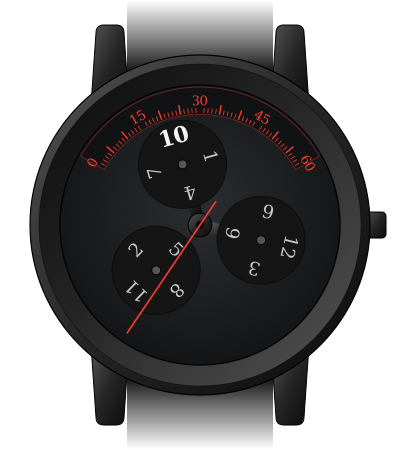
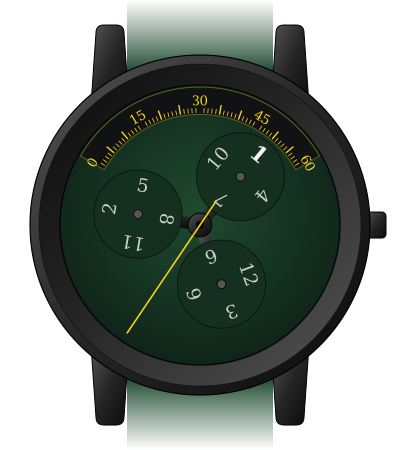
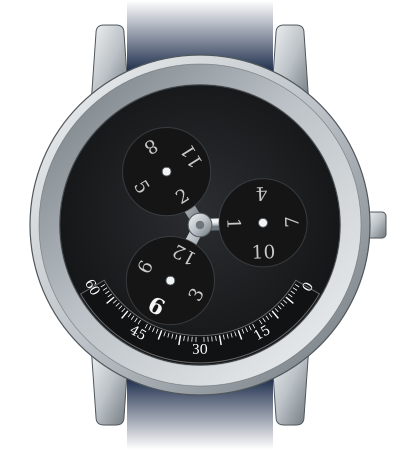
The label gets stretched. These are the near-misses worth knowing, because several are excellent watches in their own right.
Wandering jump hours — one window, a full circle. Robert Cart's 1920s module put a jumping hour numeral in a window at the tip of an arrow that circles the dial once an hour. Vincent Calabrese revived the idea as the Baladin at the end of the 1980s (and again as the 100-piece Kronos in 2017, CHF 8,800). F. P. Journe's Vagabondage I works the same way: three unique pieces for an Antiquorum charity sale in 2004, a platinum series of 69 in 2006 with ten more diamond-set, and 68 pieces in 6N gold in 2022 at CHF 86,000. The platinum piece Jean Todt gave Michael Schumacher made about US$1.65 million at Christie's in May 2024. The newest member is MB&F's M.A.D.3 “Vincent Calabrese”, launched on 1 September 2026 at CHF 2,900. All have a travelling hour — none has satellites or a minute arc.
Wandering minutes. The Daniel Roth Papillon of the late 1990s turns the idea inside out: the hour jumps in a fixed window while two retractable minute hands on a rotating carrier take turns sweeping a semicircle, driven by Maltese crosses. 250 were made (110 rose gold, 110 white gold, 30 platinum). Bulgari continued it with the Papillon Heure Sautante and Papillon Tourbillon Central (2015; the tourbillon in 40 pieces) and the Octo Roma Central Tourbillon Papillon, ref. 103475 (2021).
Orbiting hours without a minute arc. Genus GNS (2019–), by an alumnus of the Opus V project, sends hour markers around the dial edge past a fixed pointer. MCT's Sequential One and Two build the hour from rotating prisms uncovered by a jumping sector. CIGA Design's Time Cipher rides a single hour wheel on the minute arm.
Plain jump hours and disc watches. Cartier's Tank à Guichets, IWC's Pallweber, A. Lange & Söhne's Zeitwerk, the Chanel Monsieur, Louis Vuitton's Spin Time, SevenFriday's concentric discs, Ressence and Trilobe all show the hour in a fixed place. So do AP's own John Shaeffer jump-hour repeaters, refs. 25798 and 25839, and its 2026 Neo Frame Jumping Hour.
Buying notes
Set it slowly. On star-wheel-and-jumper watches such as the AP ref. 25720, spinning the crown quickly can make a disc skip a step. Advance through several hours before you buy and watch each disc index cleanly. On the AP the movement hacks when the crown is pulled even though there is no seconds hand; that is normal.
Look hard at the satellites. They are the one part nobody else makes. On an AP check each of the twelve printed numerals on the sapphire discs for loss, and the disc edges for chips. On early Urwerks check the lume and the anodised finish of the aluminium satellites.
Distrust coloured platinum dials without paperwork. The blue, purple and burgundy ref. 25720PT dials are the most valuable, nobody can prove which shades left the factory, and a loose purple dial sold on its own at Antiquorum in 2024 for CHF 2,750. Insist on an Extract from the Archives and period provenance.
Read Urwerk edition numbers from the watch, not the listing. Retailer guides regularly misstate them; the piece number engraved on the case (16/55, 58/75, 25/100) is the better evidence. Urwerk's own pre-owned shop, UR-Legends, services and warrants older pieces, and the brand has offered complimentary overhauls to auction buyers of UR-101s and UR-102s.
Service access decides value at the top end. The UR-201's hand-wound base calibre is out of production. AP still services first-generation Star Wheels — lots regularly carry AP service papers from the 2020s.
Treat microbrand limits as ceilings. Five hundred per colour across ten colours is not scarcity. Buy these to wear, at the discounted price, and expect to sell below it. The exceptions are the Vaucher-built Gorilla, which holds roughly retail, and the lottery-only Ōtsuka Lōtec.
Expect coarse minutes. On a 120° arc five minutes is ten degrees of travel; on a four-satellite Urwerk or Atowak it is seven and a half. That is the nature of the thing.
Open questions
- Which 1904 issue of the Journal suisse d'horlogerie carried “Une montre originale,” which 1820s watch it illustrated, and the number of the patent AP registered during development. None has been published.
- How many ref. 25720s exist. Case-number clusters give an order of magnitude and no more; only AP's archive can settle it.
- Calibre naming on the 25720. Archive extracts say 2224/2812; every auction house says 2124. Whether early and late watches genuinely differ is unresolved.
- Whether a white-gold or steel 25720 exists. Both are asserted in print; neither has been seen.
- Platinum dial colours. Which of blue, purple, burgundy and pink-copper left Le Brassus as such.
- Urwerk's open series. Totals for the UR-103.03, .08 and .09, the first UR-210, and the un-numbered UR-100V, UR-120 and UR-220 runs have never been stated.
- The Vacheron Constantin Sputnik (47071/000G-9314): catalogued as a “rotating disk” display; we list it as a wandering-hours watch on the strength of its reference family and calibre, not a photograph of the mechanism.
- Any true wandering-hours wristwatch between 1930 and 1991. We found none. If you own one, we would like to hear from you.
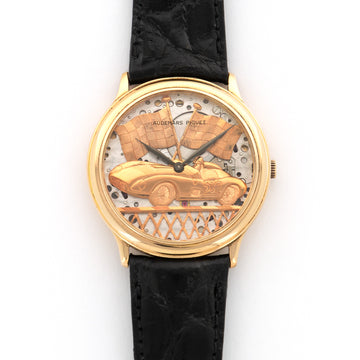
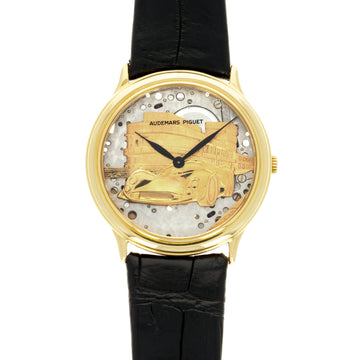
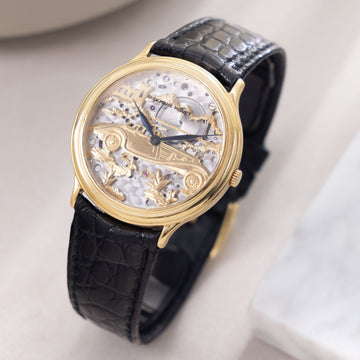
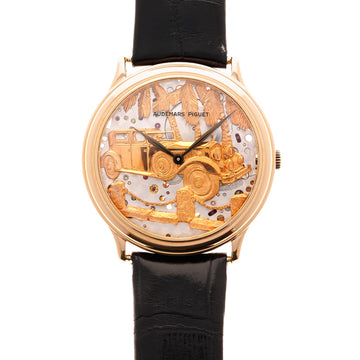
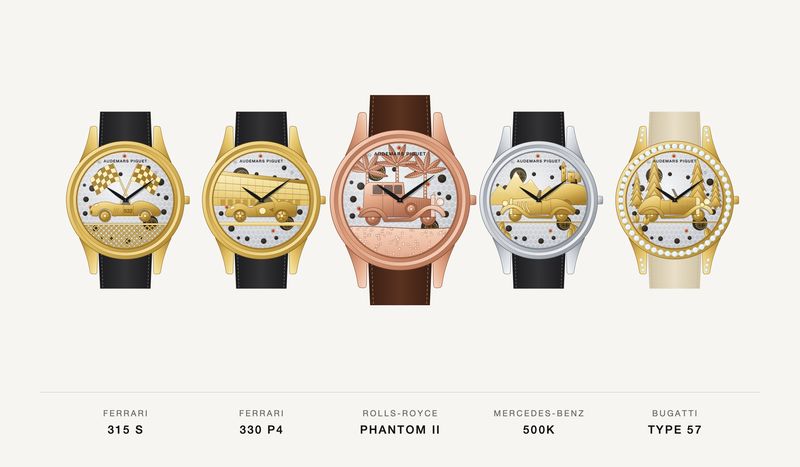
More from Audemars Piguet. Start with the complete AP Star Wheel reference for its dials, case-number clusters and auction record. Our AP retail journey covers the modern boutique experience; the hand-engraved ref. 14677 skeleton car watches show another side of the manufacture's early-1990s catalogue.
Sources and method
This guide was compiled in September 2026 from manufacturer pages and press releases (Audemars Piguet, Urwerk, Vacheron Constantin, H. Moser & Cie, Hautlence, Parmigiani Fleurier, Gorilla, Xeric, Atowak, DWISS); auction catalogues and results from Phillips, Christie's, Sotheby's, Antiquorum, Bonhams, Ineichen, Loupe This and Marteau & Co; museum records from the British Museum, the Science Museum Group, the London Museum, the V&A, the Metropolitan Museum of Art, the J. Paul Getty Museum and Museo Galileo; and reporting by SJX Watches, Monochrome, Quill & Pad, Revolution, A Collected Man, Hairspring, The 1916 Company, aBlogtoWatch, Worn & Wound, Time+Tide, Oracle Time, Gear Patrol, Europa Star, Worldtempus, Singapore Watch Club and Jack Forster. The specific pages behind each table are linked directly beneath it.
Reference numbers, years and edition sizes were checked against at least two independent sources wherever two existed. Where they conflict we print both. “Not found” means exactly that — we looked and could not verify it — and figures described as estimates are ours.
- Audemars Piguet — AP Chronicles, “Jumping Hour” (Serge Meylan, the 1904 article and AP Heritage's own wandering-hours pieces); Starwheel and the wandering hours; and the December 2022 press release.
- A Collected Man — The story of the Audemars Piguet Star Wheel.
- Singapore Watch Club — John Shaeffer: AP's best kept secret (production tables from AP's 20th Century Complicated Wristwatches).
- Jack Forster — Mass Effect: the Code 11.59 Starwheel.
- Hairspring — Burgundy-dial 25720PT.
- Monochrome — 1997–2023: the entire Urwerk collection explained.
- Quill & Pad — Felix Baumgartner, Urwerk, Harry Winston and the Opus V.
- Urwerk — historical pieces, UR-Satellite collection and UR-Legends.
- SJX Watches — In depth: the UR-150 Scorpion; Vacheron Constantin Great Explorers review.
- Worldtempus — The mysterious wandering hour.
- Alexander Barter — Innovative minute displays in the late 17th century.
- Bonhams — essay on a Campani night clock; Dreweatts essay on a Joseph Knibb night timepiece.
- Science Museum Group — wandering hour watch by Sinclare, Dublin, c. 1690.
- Google Patents — CH 130191, Robert Cart, “Indicateur de temps”.
Image credits
Illustrations and diagrams are original work by Watchphile. The Audemars Piguet illustrations are shared with our AP Star Wheel guide. Photographs are used under free licences and are credited beside each image: the AP ref. 25720 by jcw (CC BY 3.0); the UR-103T, UR-110 PTH, UR-202, UR-1001 and the founders' portrait by URWERK (CC BY-SA 3.0) and the UR-210 AlTiN by URWERK (CC BY 3.0), all released through Wikimedia's permissions process; the two UR-100 photographs by Urwerkpierre (CC BY-SA 4.0); the 1670 night clock by Daderot (CC0); and the wandering-hour watch from the Metropolitan Museum of Art's Open Access collection (CC0). All are served from Wikimedia Commons. We have not reproduced any manufacturer, dealer or auction-house photograph; the “Photos” links under each illustration lead to them.